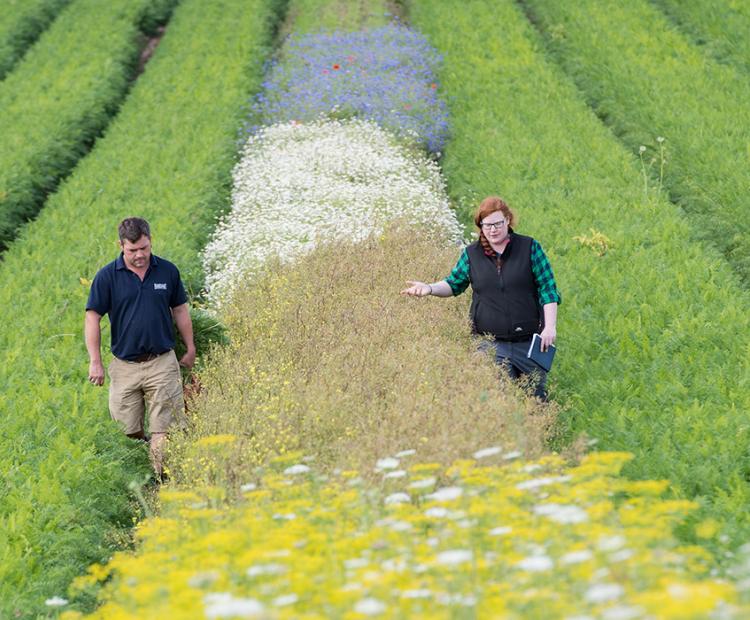
The big picture: using wildflower strips for pest control
They may be beautiful, but these strips prove pretty deadly for every farmer's mortal enemy: aphids

Human activities, including agriculture result in collateral materials usually called waste. These include for example manures from agricultural production, sewage sludge from water treatment plants that can be further used as fertiliser, due to their nutrient content. This is of benefit as it recycles these materials that otherwise would be disposed of contaminating water, soil and any other recipients used for this purpose. These recycled materials however, can also contain pollutants or too high levels of some elements that can result in harm, not only for consumers, but also to the environment, as they can promote losses to water courses (rivers, sea) and to the atmosphere, for example as greenhouse gases, the cause of climate change.This study aims to study some of these pollutants contained in manures and sewage sludge, to determine how they affect losses of nitrous oxide (a greenhouse gas) to the atmosphere.
This project is funded by the Royal Society.
In the first year, the experiment will be carried out using the Denitrification Incubation system (DENIS system) (details described below). There are 12 chambers in the laboratory system, which allows to include 3 treatments with 4 replicates for each. The impact of each targeted element on soil N2O emission will be tested in an individual experimental batch, with the N2O and other greenhouse gases emission data being continuously collected from the soil chambers for 2 weeks. The length of the each incubation (2 weeks) is determined based on the results of (Bateman and Baggs, 2005), reporting that soil N2O emission is highest after the application of the N fertilizers and is continuously decreasing until circa 10 days when the effect of the added amendment expires. The experimental soil will be collected from the pasture fields at North Wyke, United Kingdom (50.76°N, -3.90°W), where soil was sources for several previous experiments. After homogenizing by sieving using a stainless-steel sieve (2mm), soil cores will be prepared to fit the corers at near field bulk density value. The cores will be placed in the incubation system to be flushed with a He/O2 mixture to remove native N2. They will be later amended with ammonium nitrate (with total N concentration in soil column equivalent to 54 kg N/ha, (National Statistics, 2020)) with (a) no additional trace element (b) adding one of the targeted trace elements in its free ion form (metal salts) (c) adding a NI as comparison. The soil moisture will be maintained at 50% water-filled pore space (Bateman and Baggs, 2005) to simulate the aerobic condition. The concentrations of the added metal salts (CdSO4, CuSO4, ZnSO4, NiSO4) will be refer to standard concentrations of the heavy metal limits in compost.
In year 2, the UK researchers will visitTaiwan to discuss the data, visit the current on-site and laboratory GHG measurement equipment and techniques in Taiwan (National Chung-Hsing University) and visit the livestock and pasture experimental sites in the Taiwan Livestock Research Institute, Hengchun, Pingtung, Taiwan. By the end of year 2 we aim to co-writing and publishing a scientific report, providing data for future estimation of the potential impact of waste management (in both Taiwan and the UK) on GHG missions

Atmospheric Chemist

Soils Emissions Specialist
Mandy Kao, National Chung - Hsing University, Taiwan