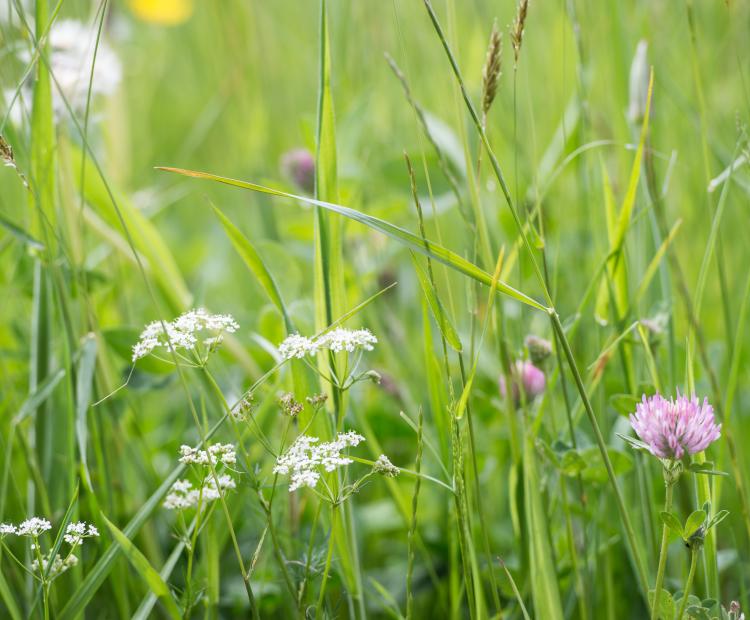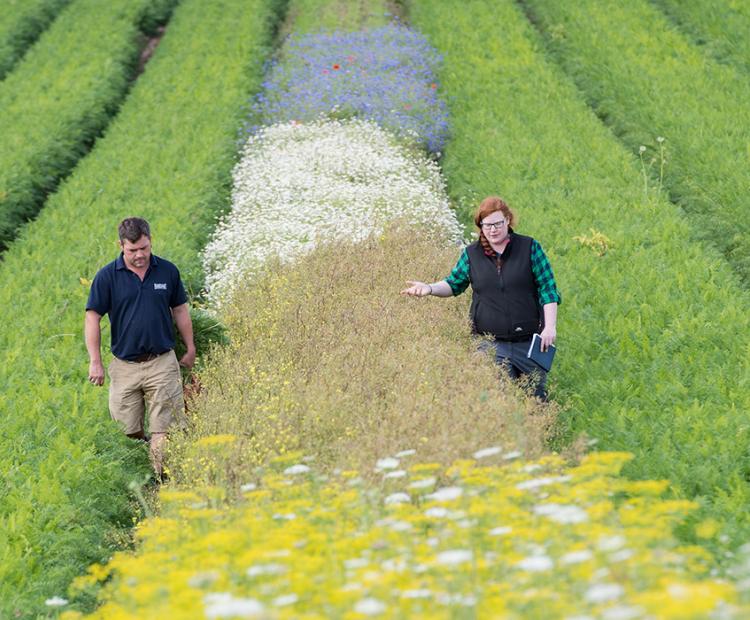
The big picture: using wildflower strips for pest control
They may be beautiful, but these strips prove pretty deadly for every farmer's mortal enemy: aphids

A joint UK–Brazil study has found that two widely used virus-based tools for probing gene function fail in rice. The newly published paper confirms that these tried-and-tested methods do not transiently alter gene expression in this crop, pointing to rice’s unique defences and the need for fresh approaches.
Researchers from Rothamsted Research and the Federal University of Rio Grande do Sul tested two popular viral vectors - barley stripe mosaic virus (BSMV) and foxtail mosaic virus (FoMV) - to see if they could temporarily switch genes on or off in rice (Oryza sativa). These virus-enabled reverse genetics (VERG) techniques are regularly used in plants to study gene function without permanent genetic modification. These methods have worked well at Rothamsted in wheat and blackgrass producing clear results: plants turn white when a chlorophyll gene is silenced, or glow green when a fluorescent protein is expressed. In rice, no such changes occurred. Despite extensive optimisation across six rice cultivars, the team found no evidence that these VERG techniques work in rice.
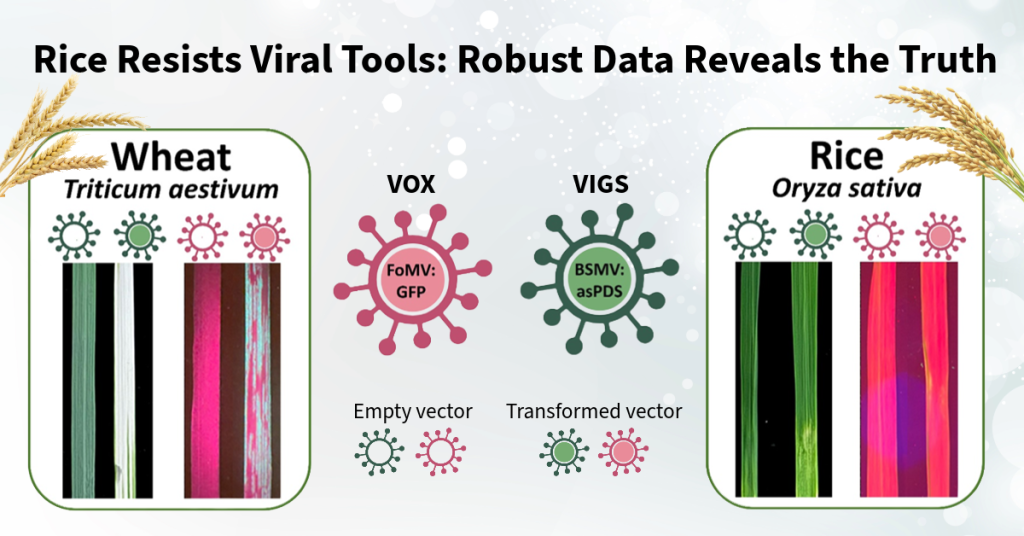
“Although we don’t know why they didn’t work, it’s clear they don’t,” said Guilherme Turra, lead author and PhD student at the Federal University of Rio Grande do Sul. “Rather than chase every possible explanation, we focused on rigorously testing variations of established protocols and inoculation methods across different rice types. By using robust scientific methods and clear visual phenotypes, we can be confident these tools simply don’t deliver in rice.”
Building on that point, Dr Dana MacGregor, senior author at Rothamsted, said: “It’s important to trust robust data, even when it challenges your original hypothesis. As scientists, we need to stay open to the possibility that our approach or assumption was wrong. We assumed what works in wheat would work in rice, but our data clearly show otherwise. By sharing these results, we hope to help others avoid the same pitfalls.”
The findings, now peer-reviewed and published in Annals of Applied Biology, underscore the species-specific nature of VERG and the importance of sharing negative results to guide future research. By publishing these data, the team hopes to prevent others from repeating unsuccessful experiments and to encourage innovation in viral systems tailored to rice.
The work was supported by the UK’s Biotechnology and Biological Sciences Research Council (BBSRC), Rio Grande do Sul State’s Research Support Foundation (FAPERGS) and Brazil’s CAPES programme.

Weed Molecular Biologist
Rothamsted Research is the longest-running agricultural research institute in the world. We work from gene to field with a proud history of ground-breaking
discoveries in areas as diverse as crop management, statistical interpretation and soil health. Our founders, in 1843, were the pioneers of modern
agriculture, and we are known for our imaginative science and our collaborative approach to developing innovative farm practice.
Through independent research, we make significant contributions to improving agri-food systems in the UK and internationally, with
economic impact estimated to exceed £3 bn in annual contribution to the UK economy. Our strength lies in our systems approach, which combines strategic research,
interdisciplinary teams and multiple partnerships.
Rothamsted is home to three unique National Bioscience Research Infrastructures which are open to researchers from all over the world:
The Long-Term Experiments,
Rothamsted Insect Survey and the
North Wyke Farm Platform.
We are strategically funded by the Biotechnology and Biological Sciences Research Council (BBSRC), with additional support from other national and
international funding streams, and from industry. We are also supported by the Lawes Agricultural Trust (LAT).
The Biotechnology and Biological Sciences Research Council is part of UK Research and Innovation, a non-departmental public body funded by a grant-in-aid
from the UK government.
BBSRC invests to push back the frontiers of biology and deliver a healthy, prosperous and sustainable future. Through our investments, we build and support a vibrant,
dynamic and inclusive community which delivers ground-breaking discoveries and develops bio-based solutions that contribute to tackling global challenges,
such as sustainable food production, climate change, and healthy ageing.
As part of UK Research and Innovation (UKRI), we not only play a pivotal role in fostering connections that enable the UK’s world-class research and innovation system
to flourish – we also have a responsibility to enable the creation of a research culture that is diverse, resilient, and engaged.
BBSRC proudly forges interdisciplinary collaborations where excellent bioscience has a fundamental role. We pioneer approaches that enhance the equality, diversity,
and inclusion of talent by investing in people, infrastructure, technologies, and partnerships on a global scale.
The Lawes Agricultural Trust, established in 1889 by Sir John Bennet Lawes, supports Rothamsted Research’s national and international agricultural science through the provision of land, facilities and funding. LAT, a charitable trust, owns the estates at Harpenden and Broom's Barn, including many of the buildings used by Rothamsted Research. LAT provides an annual research grant to the Director, accommodation for nearly 200 people, and support for fellowships for young scientists from developing countries. LAT also makes capital grants to help modernise facilities at Rothamsted, or invests in new buildings.