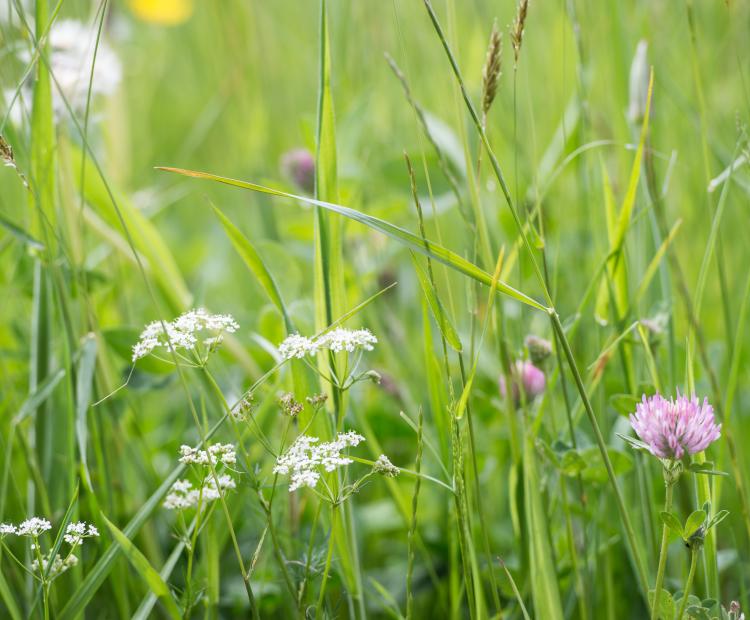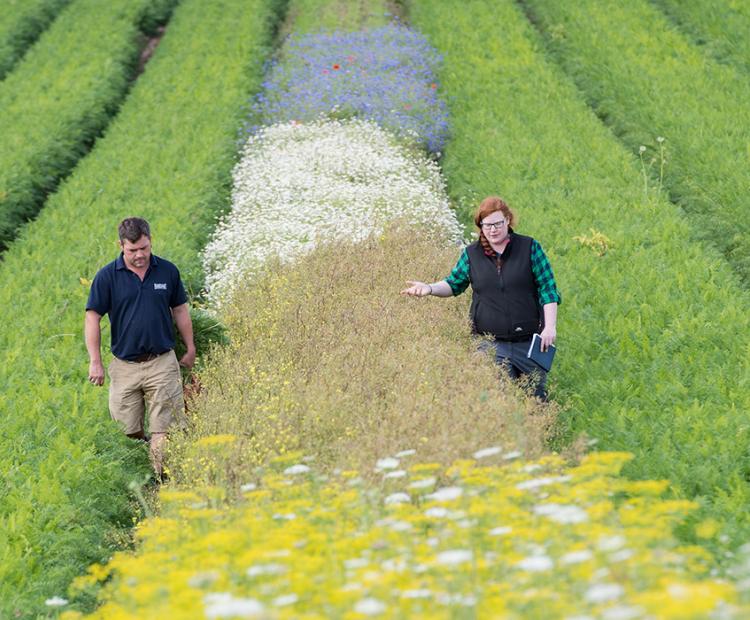
The big picture: using wildflower strips for pest control
They may be beautiful, but these strips prove pretty deadly for every farmer's mortal enemy: aphids

A pioneering initiative developing low-energy techniques to convert cultivated kelp into a liquid biostimulant and livestock feed supplement has outperformed early field-trial expectations and moved decisively closer to commercial launch.
Backed by Innovate UK and working alongside Algapelago Marine Limited and the UK Agri-Tech Centre, scientists at Rothamsted designed and delivered rigorous controlled-environment trials to test how the prototype performs under abiotic stress, including drought.
Using our specialist infrastructure, we examined four foliar application rates on wheat and field bean under both well-watered and drought conditions. A second phase compared foliar and soil-based applications in wheat. These trials allowed us to pinpoint optimal dosing strategies and understand how the product interacts with plant development and soil biology.
The results confirmed that under specific conditions, kelp-derived biostimulants can deliver measurable improvements in crop growth and yield. Dr Marieme Drame, Scientific Technician at Rothamsted Research, said:
“Kelp-derived biostimulants offer a systems-based solution that works with plant and soil biology to enhance crop performance. At the optimal application rate in our wheat trials, we observed improved growth and yield, along with positive indirect effects on soil microbial activity, demonstrating clear value for productive and resilient farming systems.”
Beyond yield, we observed encouraging signals of enhanced soil microbial activity, pointing to wider system-level benefits. This is particularly important as agriculture adapts to more frequent drought events and increasing pressure to reduce chemical inputs.
Dr Hari Ram Upadhayay, Scientist in Agroecosystem Biogeochemistry at Rothamsted Research, emphasised the importance of cross-sector collaboration in delivering credible innovation:
“Collaboration is a key to driving innovation. Here, kelp-derived biostimulants innovation holds major promise for supporting sustainable intensification as agriculture adapts to a changing climate.”
Professor Adie Collins, Science Director at Rothamsted Research, added:
“This project provides a good example of how industry and science teams can co-work together to ensure robust evidence is assembled on potential new interventions in support of sustainable and resilient agriculture in a changing and challenging world.”
The UK agri-seaweed sector has traditionally relied on wild-harvested material, but demand for sustainable, cultivated alternatives is rising rapidly. Kerr Jeferies, Market Research & Partnerships Manager at Algapelago, said:
“The insights from our direct engagement with growers have been invaluable. Hearing directly from leading farm managers and agronomists has sharpened our focus and made us even more confident in the product’s potential and market fit. We’re excited to continue engaging with these partners as we go from prototype to full commercialisation of the UK cultivated kelp biostimulant.”

Science Director

PHD STUDENT

Research Scientist
Rothamsted Research is the longest-running agricultural research institute in the world. We work from gene to field with a proud history of ground-breaking
discoveries in areas as diverse as crop management, statistical interpretation and soil health. Our founders, in 1843, were the pioneers of modern
agriculture, and we are known for our imaginative science and our collaborative approach to developing innovative farm practice.
Through independent research, we make significant contributions to improving agri-food systems in the UK and internationally, with
economic impact estimated to exceed £3 bn in annual contribution to the UK economy. Our strength lies in our systems approach, which combines strategic research,
interdisciplinary teams and multiple partnerships.
Rothamsted is home to three unique National Bioscience Research Infrastructures which are open to researchers from all over the world:
The Long-Term Experiments,
Rothamsted Insect Survey and the
North Wyke Farm Platform.
We are strategically funded by the Biotechnology and Biological Sciences Research Council (BBSRC), with additional support from other national and
international funding streams, and from industry. We are also supported by the Lawes Agricultural Trust (LAT).
The Biotechnology and Biological Sciences Research Council is part of UK Research and Innovation, a non-departmental public body funded by a grant-in-aid
from the UK government.
BBSRC invests to push back the frontiers of biology and deliver a healthy, prosperous and sustainable future. Through our investments, we build and support a vibrant,
dynamic and inclusive community which delivers ground-breaking discoveries and develops bio-based solutions that contribute to tackling global challenges,
such as sustainable food production, climate change, and healthy ageing.
As part of UK Research and Innovation (UKRI), we not only play a pivotal role in fostering connections that enable the UK’s world-class research and innovation system
to flourish – we also have a responsibility to enable the creation of a research culture that is diverse, resilient, and engaged.
BBSRC proudly forges interdisciplinary collaborations where excellent bioscience has a fundamental role. We pioneer approaches that enhance the equality, diversity,
and inclusion of talent by investing in people, infrastructure, technologies, and partnerships on a global scale.
The Lawes Agricultural Trust, established in 1889 by Sir John Bennet Lawes, supports Rothamsted Research’s national and international agricultural science through the provision of land, facilities and funding. LAT, a charitable trust, owns the estates at Harpenden and Broom's Barn, including many of the buildings used by Rothamsted Research. LAT provides an annual research grant to the Director, accommodation for nearly 200 people, and support for fellowships for young scientists from developing countries. LAT also makes capital grants to help modernise facilities at Rothamsted, or invests in new buildings.