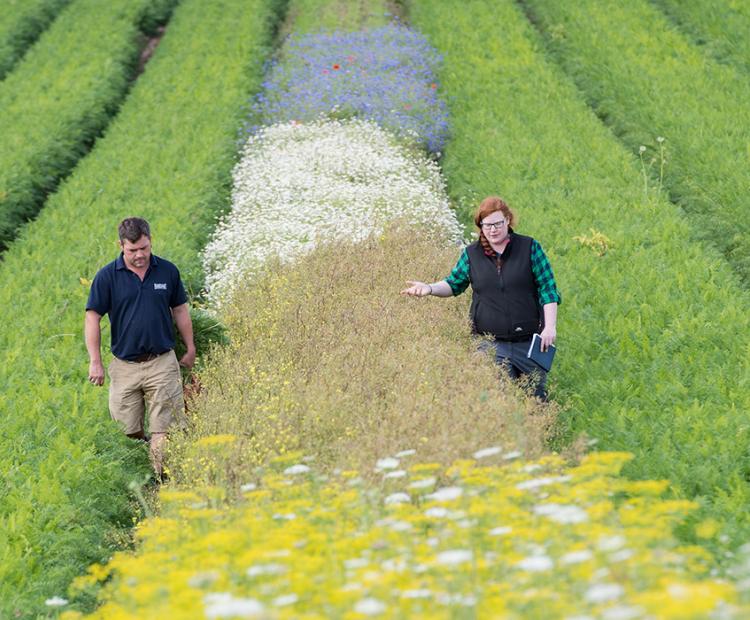
The big picture: using wildflower strips for pest control
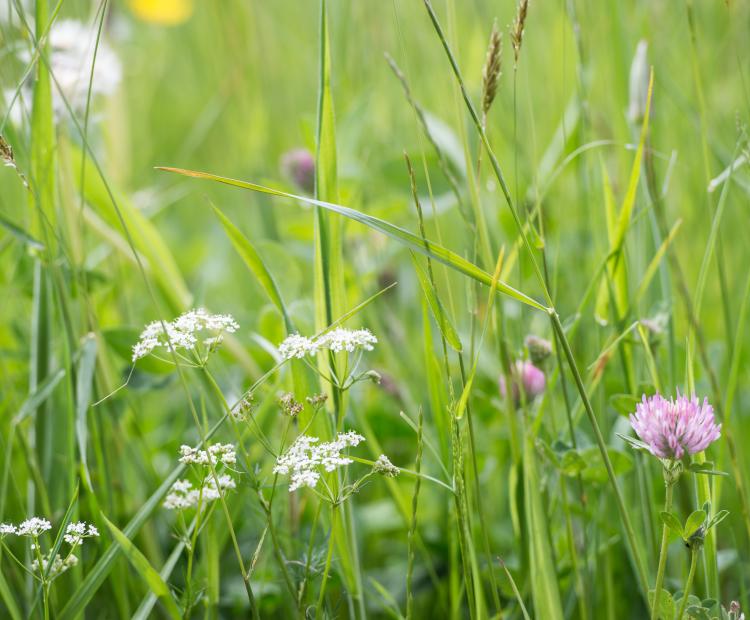
They may be beautiful, but these strips prove pretty deadly for every farmer's mortal enemy: aphids
New research shows that maize plants subjected to simultaneous attack above and belowground release a distinct blend of root chemicals that strongly attracts wireworms. These pests damage roots and seeds, leading to major yield losses.
The study found that when maize roots are fed on by wireworms while leaves are also attacked by European corn borer caterpillars, the plant produces a unique chemical signature composed of small lipophilic molecules in the rhizosphere, the narrow zone of soil surrounding roots. Wireworms were far more attracted to these dual-attacked plants than to undamaged plants or those facing a single pest. Researchers recreated this chemical cue as a synthetic blend, which successfully attracted wireworms not only in the laboratory, but also in semi-field and field conditions. The findings offer rare insight into how plants coordinate responses to multiple attackers and highlight the rhizosphere as a largely untapped frontier for crop protection.
“Most research on insect communication in crops has focused above ground, but a huge amount of ecological interaction happens below the soil surface,” said Dr József Vuts from Rothamsted Research, “We’ve shown that root chemicals can shape the behaviour of a major pest, creating exciting opportunities for smarter and more sustainable pest management.”
The findings suggest these newly identified chemical cues could be harnessed in attract-and-trap systems or other ecologically based strategies to manage wireworms, reducing reliance on conventional pesticides.
The study also deepens understanding of how plants integrate attacks across different tissues. Rather than responding independently to root and leaf damage, maize mounts a systemic response that alters its chemistry and, in turn, pest behaviour. The researchers note that these root-derived compounds likely operate alongside other cues, such as carbon dioxide and soil conditions, that help guide wireworms to host plants.
Beyond pest management, the work sheds light on the rhizosphere as a dynamic yet poorly understood environment, where plants, insects and microbes constantly interact. The researchers say identifying which individual compounds drive wireworm attraction will be a key next step.

Chemical Ecologist
Rothamsted Research is the longest-running agricultural research institute in the world. We work from gene to field with a proud history of ground-breaking
discoveries in areas as diverse as crop management, statistical interpretation and soil health. Our founders, in 1843, were the pioneers of modern
agriculture, and we are known for our imaginative science and our collaborative approach to developing innovative farm practice.
Through independent research, we make significant contributions to improving agri-food systems in the UK and internationally, with
economic impact estimated to exceed £3 bn in annual contribution to the UK economy. Our strength lies in our systems approach, which combines strategic research,
interdisciplinary teams and multiple partnerships.
Rothamsted is home to three unique National Bioscience Research Infrastructures which are open to researchers from all over the world:
The Long-Term Experiments,
Rothamsted Insect Survey and the
North Wyke Farm Platform.
We are strategically funded by the Biotechnology and Biological Sciences Research Council (BBSRC), with additional support from other national and
international funding streams, and from industry. We are also supported by the Lawes Agricultural Trust (LAT).
The Biotechnology and Biological Sciences Research Council is part of UK Research and Innovation, a non-departmental public body funded by a grant-in-aid
from the UK government.
BBSRC invests to push back the frontiers of biology and deliver a healthy, prosperous and sustainable future. Through our investments, we build and support a vibrant,
dynamic and inclusive community which delivers ground-breaking discoveries and develops bio-based solutions that contribute to tackling global challenges,
such as sustainable food production, climate change, and healthy ageing.
As part of UK Research and Innovation (UKRI), we not only play a pivotal role in fostering connections that enable the UK’s world-class research and innovation system
to flourish – we also have a responsibility to enable the creation of a research culture that is diverse, resilient, and engaged.
BBSRC proudly forges interdisciplinary collaborations where excellent bioscience has a fundamental role. We pioneer approaches that enhance the equality, diversity,
and inclusion of talent by investing in people, infrastructure, technologies, and partnerships on a global scale.
The Lawes Agricultural Trust, established in 1889 by Sir John Bennet Lawes, supports Rothamsted Research’s national and international agricultural science through the provision of land, facilities and funding. LAT, a charitable trust, owns the estates at Harpenden and Broom's Barn, including many of the buildings used by Rothamsted Research. LAT provides an annual research grant to the Director, accommodation for nearly 200 people, and support for fellowships for young scientists from developing countries. LAT also makes capital grants to help modernise facilities at Rothamsted, or invests in new buildings.