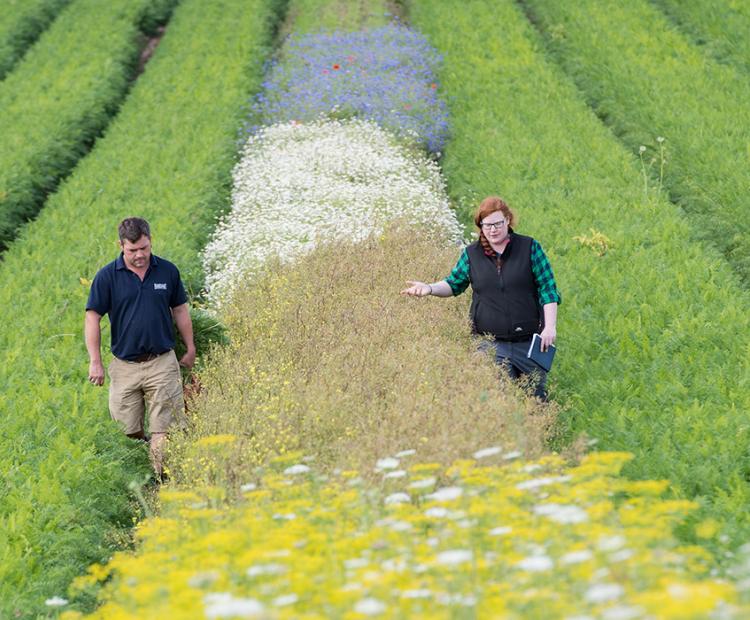
The big picture: using wildflower strips for pest control
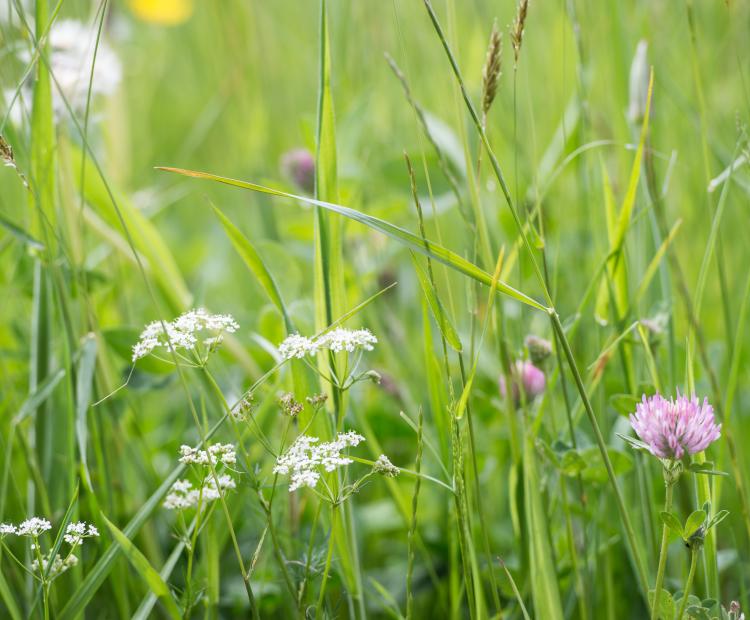
They may be beautiful, but these strips prove pretty deadly for every farmer's mortal enemy: aphids
Professor David E. Salt and Professor Martin Broadley are the winners of the prestigious 2026 Rank Prize for Nutrition. Fusing advances in high-throughput elemental profiling with genetics, their ground-breaking research has revealed how plants accumulate mineral nutrients and trace elements from the soil. Their research is transforming dietary interventions in low and middle-income countries, through profiling soil and crop quality, to enhance nutrition and health outcomes. Founded in 1972 by the British industrialist and philanthropist Lord J. Arthur Rank, the Rank Prize is awarded biennially in the fields of nutrition and optoelectronics. The Prize will be awarded formally at an event in London in June 2026.
 Martin said “I am deeply honoured to receive this award with David, which reflects the dedication and collaboration of an outstanding team of colleagues and partners over the past two decades. Addressing hidden hunger through improving crop nutrition, in the context of more nutritionally aware agricultural and food systems, remain global priorities, and this recognition underscores the vital role of science in building these more sustainable and resilient futures. I look forward to continuing our work to deliver solutions that improve health and livelihoods of people worldwide”.
Micronutrient deficiencies—often termed “hidden hunger”—affect billions of people worldwide, particularly in regions where diets are dominated by staple crops low in essential minerals, notably in many countries in sub-Saharan Africa and South Asia. Professors David E. Salt and Martin Broadley have led pioneering research to understand the dynamics of mineral elements in soils and plants, with a particular focus on improving the content of essential mineral nutrients in food crops and the impact on human health.
Martin has focused on translating the fundamental understanding of mineral elements in soils and crops into practical agricultural interventions and surveillance. His work spans soil and crop sciences through to nutrition and public health, with a strong emphasis on biofortification: using agronomic and genetic approaches to increase the concentration of essential nutrients in edible crops. His collaborations in several countries in sub-Saharan Africa and South Asia have supported the development of regionally adapted crop varieties and farming practices that improve dietary mineral intake.
Professors Salt and Broadley have demonstrated that improving the mineral content of food crops is not only scientifically feasible but also socially and economically impactful. Their research has informed national and international strategies to combat micronutrient deficiencies, including the use of micronutrient-enriched fertilizers in Malawi and the development of zinc-rich wheat varieties for South Asia. Their work is helping to shape food systems that are more resilient, equitable and health-promoting.
Interim CEO
Rothamsted Research is the longest-running agricultural research institute in the world. We work from gene to field with a proud history of ground-breaking
discoveries in areas as diverse as crop management, statistical interpretation and soil health. Our founders, in 1843, were the pioneers of modern
agriculture, and we are known for our imaginative science and our collaborative approach to developing innovative farm practice.
Through independent research, we make significant contributions to improving agri-food systems in the UK and internationally, with
economic impact estimated to exceed £3 bn in annual contribution to the UK economy. Our strength lies in our systems approach, which combines strategic research,
interdisciplinary teams and multiple partnerships.
Rothamsted is home to three unique National Bioscience Research Infrastructures which are open to researchers from all over the world:
The Long-Term Experiments,
Rothamsted Insect Survey and the
North Wyke Farm Platform.
We are strategically funded by the Biotechnology and Biological Sciences Research Council (BBSRC), with additional support from other national and
international funding streams, and from industry. We are also supported by the Lawes Agricultural Trust (LAT).
The Biotechnology and Biological Sciences Research Council is part of UK Research and Innovation, a non-departmental public body funded by a grant-in-aid
from the UK government.
BBSRC invests to push back the frontiers of biology and deliver a healthy, prosperous and sustainable future. Through our investments, we build and support a vibrant,
dynamic and inclusive community which delivers ground-breaking discoveries and develops bio-based solutions that contribute to tackling global challenges,
such as sustainable food production, climate change, and healthy ageing.
As part of UK Research and Innovation (UKRI), we not only play a pivotal role in fostering connections that enable the UK’s world-class research and innovation system
to flourish – we also have a responsibility to enable the creation of a research culture that is diverse, resilient, and engaged.
BBSRC proudly forges interdisciplinary collaborations where excellent bioscience has a fundamental role. We pioneer approaches that enhance the equality, diversity,
and inclusion of talent by investing in people, infrastructure, technologies, and partnerships on a global scale.
The Lawes Agricultural Trust, established in 1889 by Sir John Bennet Lawes, supports Rothamsted Research’s national and international agricultural science through the provision of land, facilities and funding. LAT, a charitable trust, owns the estates at Harpenden and Broom's Barn, including many of the buildings used by Rothamsted Research. LAT provides an annual research grant to the Director, accommodation for nearly 200 people, and support for fellowships for young scientists from developing countries. LAT also makes capital grants to help modernise facilities at Rothamsted, or invests in new buildings.