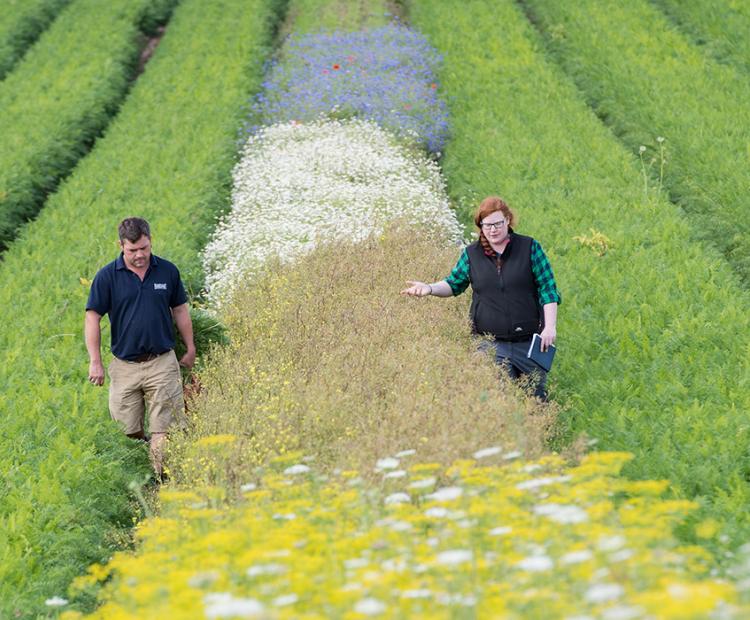
The big picture: using wildflower strips for pest control
They may be beautiful, but these strips prove pretty deadly for every farmer's mortal enemy: aphids
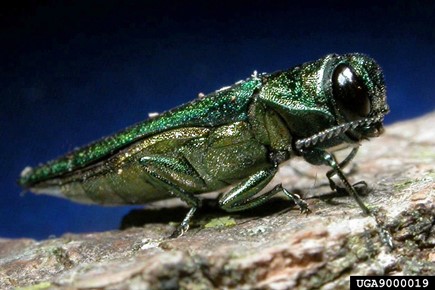
Ash trees in Great Britain are already under severe pressure from ash dieback, a disease expected to cost the UK up to £15 billion over the next 100 years. The emerald ash borer (EAB), an invasive beetle responsible for the death of millions of trees across North America and parts of Eastern Europe, represents a second threat to ash trees in Great Britain. New research by scientists at Rothamsted Research, the University of Warwick, Forest Research, and the Stockholm Environment Institute, University of York shows that the ability to slow or contain this pest will depend not only on biological factors but also on the responses of different types of land managers across Great Britain.
“We know from North America that emerald ash borer is exceptionally hard to manage once established,” said Dr Vasthi Alonso Chávez, “Our work shows that the way that land managers inspect, report and act on invasive threats has a very important role to play in tree health surveillance strategies.”
What the study found
The study combines a biological model of emerald ash borer (EAB) arrival and spread with a dynamic model of land managers’ decision making based on interviews, workshops and survey responses from more than 400 stakeholders. The study investigates how different forms of surveillance and management might influence the course of an EAB invasion in three contrasting landscapes of Great Britain: Kent, Suffolk and North Wales.
Using simulations, the researchers evaluated how EAB might be detected and managed under three different surveillance scenarios: targeted trapping at high-risk locations (e.g. ports and firewood depots), routine health and safety inspections, and voluntary surveillance by land managers.
The results show that early detection of the emerald ash borer is difficult because the larvae remain hidden inside trees for several years before symptoms appear. Official traps placed near ports and depots helped delay the spread in some cases, but trapping alone rarely led to eradication.
Routine tree inspections carried out for health and safety reasons proved to be important in the delay of EAB spread. Although they typically detect the beetle when trees are already in decline, these actions slowed local spread by prompting reporting and statutory response.
Volunteer-based surveillance, in which land managers visually assessed trees for signs of EAB or deployed traps on their own land, appears to have great potential for pest detection. However, uptake of voluntary monitoring is heavily affected by land managers’ awareness, perceived efficacy of detection and management, and costs. When the model included financial support for traps, eradication became feasible in a small but meaningful fraction of the scenario simulations.
Overall, eradication of the emerald ash borer was rare under standard assumptions, occurring in fewer than 1% of simulations. This reinforces a well-established principle: pests with long cryptic phases and capacity for long-distance spread are extremely challenging to eliminate once established.
What this means for land managers and policy makers
Land managers are often the first line of defence. Regular inspections, accurate reporting and participation in surveillance schemes could substantially reduce the rate of emerald ash borer spread. Even when eradication is unlikely, slowing its spread buys time, protects neighbouring sites and supports coordinated control.
Our research shows that clear guidance, trusted reporting routes and financial help for trapping are key to sustaining long-term engagement. Additionally, policies that recognise the practical and economic pressures that land managers face are more likely to succeed.
Emerald ash borer, if it arrives, will be difficult to manage. But this research shows that collective action by informed and supported land managers can make a measurable difference to the future of ash in Great Britain.
This research was funded by the Natural Environment Research Council (NERC) project (NE/T007729/1).
Rothamsted Research receives strategic funding from the Biotechnology and Biological Sciences Research Council of the United Kingdom (BBSRC).
Forest Research Forest Research (FR) is the research agency of the Forestry Commission (FC) and Great Britain’s principal organisation for forestry and tree-related research. Forest Research is internationally renowned for the provision of science, research, evidence, data and services in support of sustainable forestry.

Spatial Statistician

Epidemiological Modeller
Rothamsted Research is the longest-running agricultural research institute in the world. We work from gene to field with a proud history of ground-breaking
discoveries in areas as diverse as crop management, statistical interpretation and soil health. Our founders, in 1843, were the pioneers of modern
agriculture, and we are known for our imaginative science and our collaborative approach to developing innovative farm practice.
Through independent research, we make significant contributions to improving agri-food systems in the UK and internationally, with
economic impact estimated to exceed £3 bn in annual contribution to the UK economy. Our strength lies in our systems approach, which combines strategic research,
interdisciplinary teams and multiple partnerships.
Rothamsted is home to three unique National Bioscience Research Infrastructures which are open to researchers from all over the world:
The Long-Term Experiments,
Rothamsted Insect Survey and the
North Wyke Farm Platform.
We are strategically funded by the Biotechnology and Biological Sciences Research Council (BBSRC), with additional support from other national and
international funding streams, and from industry. We are also supported by the Lawes Agricultural Trust (LAT).
The Biotechnology and Biological Sciences Research Council is part of UK Research and Innovation, a non-departmental public body funded by a grant-in-aid
from the UK government.
BBSRC invests to push back the frontiers of biology and deliver a healthy, prosperous and sustainable future. Through our investments, we build and support a vibrant,
dynamic and inclusive community which delivers ground-breaking discoveries and develops bio-based solutions that contribute to tackling global challenges,
such as sustainable food production, climate change, and healthy ageing.
As part of UK Research and Innovation (UKRI), we not only play a pivotal role in fostering connections that enable the UK’s world-class research and innovation system
to flourish – we also have a responsibility to enable the creation of a research culture that is diverse, resilient, and engaged.
BBSRC proudly forges interdisciplinary collaborations where excellent bioscience has a fundamental role. We pioneer approaches that enhance the equality, diversity,
and inclusion of talent by investing in people, infrastructure, technologies, and partnerships on a global scale.
The Lawes Agricultural Trust, established in 1889 by Sir John Bennet Lawes, supports Rothamsted Research’s national and international agricultural science through the provision of land, facilities and funding. LAT, a charitable trust, owns the estates at Harpenden and Broom's Barn, including many of the buildings used by Rothamsted Research. LAT provides an annual research grant to the Director, accommodation for nearly 200 people, and support for fellowships for young scientists from developing countries. LAT also makes capital grants to help modernise facilities at Rothamsted, or invests in new buildings.