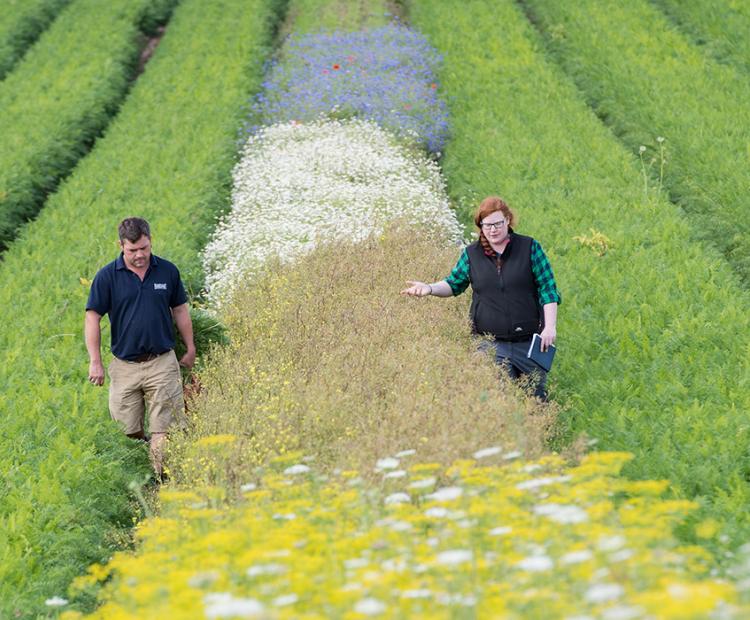
The big picture: using wildflower strips for pest control
They may be beautiful, but these strips prove pretty deadly for every farmer's mortal enemy: aphids
As the climate changes, farmers around the world are facing more frequent and intense weather extremes. While drought has long been seen as the main danger to wheat crops, this new study suggests that heatwaves at a key moment in the plant’s life cycle may soon pose an even greater risk.
Flowering is a critical moment
Dr Mikhail Semenov, Mathematical Modeller and Emeritus Fellow at Rothamsted Research said: “Flowering is one of the most sensitive stages in wheat development. It’s when the plant sets grain, which ultimately determines yield. Even a few days of very high temperatures or severe water stress at this stage can reduce grain numbers and significantly cut final harvests.”
The study used advanced climate projections and the Sirius wheat model to estimate how short, intense heatwaves and droughts during flowering could affect global wheat yields in the future.
What the research found
The results show a clear shift in risk - drought during flowering currently causes more yield loss than heat. However, its overall global impact is expected to decline slightly in the future. Heat stress during flowering, on the other hand, it is projected to become much more damaging. By 2050, global yield losses linked to extreme heat at flowering could rise by about one-third. By 2090, those losses could increase by more than three-quarters.
While drought remains important, extreme heat at flowering is set to become a growing challenge for wheat growers worldwide. Professor Malcolm Hawkesford, Leader of the “Delivering Sustainable Wheat” Institute Strategic Programme at Rothamsted Research said: “This kind of modelling studies provide critical information on, and pointers to, the traits we should be breeding for now, ready for predicted future climate conditions.”
What this means for farmers
For farmers, this highlights the importance of:
Plant breeders will also need to place greater emphasis on developing wheat varieties that can cope with short bursts of high temperature during flowering.
Looking ahead
With global demand for wheat continuing to grow, protecting yields under changing weather patterns is essential for food security. This research shows that preparing for heat stress - not just drought - will be key to keeping wheat production stable in the decades ahead. By understanding when crops are most vulnerable, farmers and researchers can work together to build more resilient farming systems for the future.

Delivering Sustainable Wheat (ISP) Leader

Crop Scientist

Botanist
Rothamsted Research is the longest-running agricultural research institute in the world. We work from gene to field with a proud history of ground-breaking
discoveries in areas as diverse as crop management, statistical interpretation and soil health. Our founders, in 1843, were the pioneers of modern
agriculture, and we are known for our imaginative science and our collaborative approach to developing innovative farm practice.
Through independent research, we make significant contributions to improving agri-food systems in the UK and internationally, with
economic impact estimated to exceed £3 bn in annual contribution to the UK economy. Our strength lies in our systems approach, which combines strategic research,
interdisciplinary teams and multiple partnerships.
Rothamsted is home to three unique National Bioscience Research Infrastructures which are open to researchers from all over the world:
The Long-Term Experiments,
Rothamsted Insect Survey and the
North Wyke Farm Platform.
We are strategically funded by the Biotechnology and Biological Sciences Research Council (BBSRC), with additional support from other national and
international funding streams, and from industry. We are also supported by the Lawes Agricultural Trust (LAT).
The Biotechnology and Biological Sciences Research Council is part of UK Research and Innovation, a non-departmental public body funded by a grant-in-aid
from the UK government.
BBSRC invests to push back the frontiers of biology and deliver a healthy, prosperous and sustainable future. Through our investments, we build and support a vibrant,
dynamic and inclusive community which delivers ground-breaking discoveries and develops bio-based solutions that contribute to tackling global challenges,
such as sustainable food production, climate change, and healthy ageing.
As part of UK Research and Innovation (UKRI), we not only play a pivotal role in fostering connections that enable the UK’s world-class research and innovation system
to flourish – we also have a responsibility to enable the creation of a research culture that is diverse, resilient, and engaged.
BBSRC proudly forges interdisciplinary collaborations where excellent bioscience has a fundamental role. We pioneer approaches that enhance the equality, diversity,
and inclusion of talent by investing in people, infrastructure, technologies, and partnerships on a global scale.
The Lawes Agricultural Trust, established in 1889 by Sir John Bennet Lawes, supports Rothamsted Research’s national and international agricultural science through the provision of land, facilities and funding. LAT, a charitable trust, owns the estates at Harpenden and Broom's Barn, including many of the buildings used by Rothamsted Research. LAT provides an annual research grant to the Director, accommodation for nearly 200 people, and support for fellowships for young scientists from developing countries. LAT also makes capital grants to help modernise facilities at Rothamsted, or invests in new buildings.