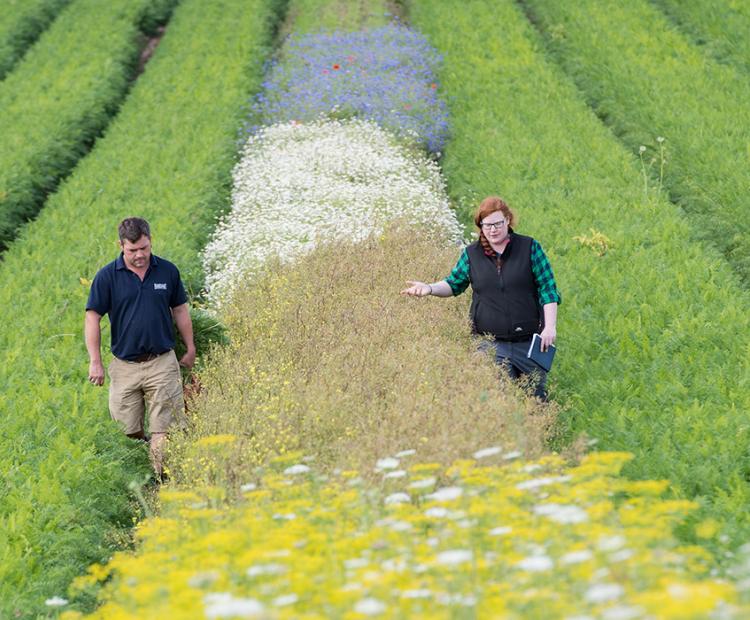
The big picture: using wildflower strips for pest control
They may be beautiful, but these strips prove pretty deadly for every farmer's mortal enemy: aphids
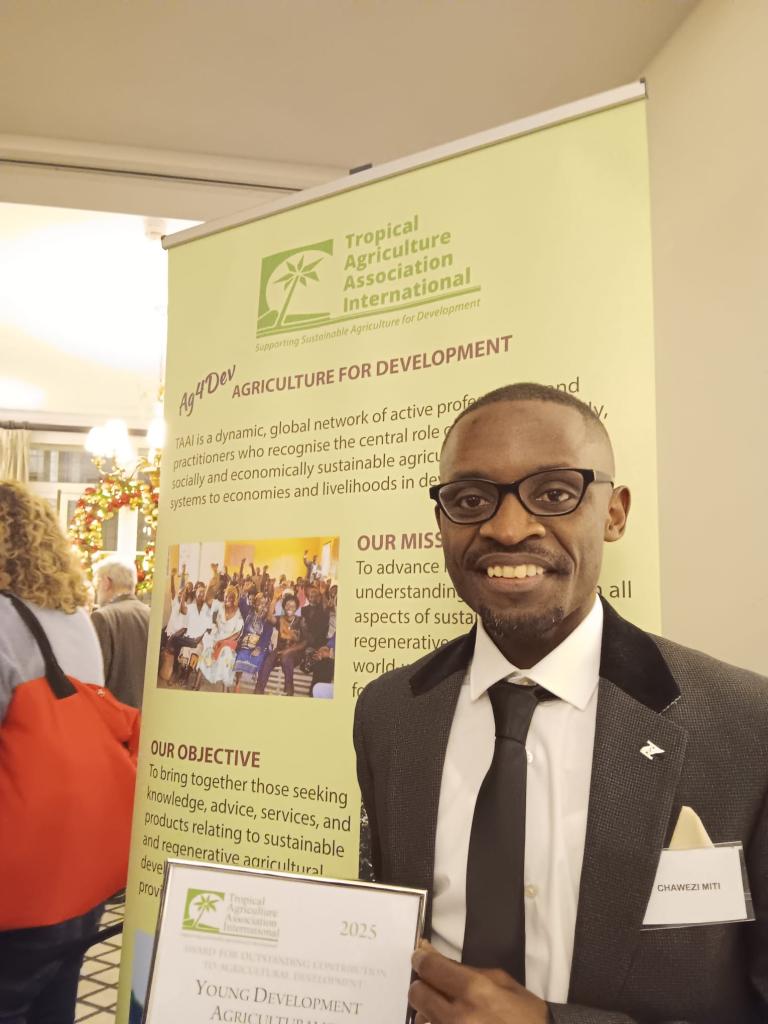 The Tropical Agriculture Association International (TAAI) has announced that Chawezi has been selected as the recipient of the prestigious Young Development Agriculturalist (UK-based) award for 2025. This annual honour celebrates outstanding contributions to sustainable agricultural development, and this year’s recognition highlights Chawezi’s innovative work at the intersection of agricultural statistics, capacity building, and development practice.
Chawezi, who recently completed his PhD with Rothamsted and University of Nottingham through the Graduate Centre for International Agriculture, has been conducting research as part of his doctoral project titled Boundary line methodology for yield gap analysis of farm systems. Under the supervision of Prof. Murray Lark (University of Nottingham), Dr. Alice Milne (Rothamsted Research), and Prof. Ken Giller (Wageningen University), he has produced influential work that is already reshaping how researchers approach crop performance analysis.
According to the TAAI Honours Panel, his nomination stood out for the depth and originality of his research—particularly his critical review of boundary line models used in yield gap analysis. His findings challenged long-established assumptions and laid the foundation for methodological improvements that have since strengthened the accuracy and robustness of boundary line approaches. As global agriculture faces the pressures of climate change, resource scarcity, and the need for sustainable intensification, improved statistical tools are crucial. Chawezi's contributions offers researchers and practitioners more accurate ways to diagnose yield gaps and design interventions that respond to real-world limitations faced by farmers.
David Radcliffe Chair of TAAI Honours Panel mentioned, "TAA International is particularly keen to encourage young agricultural scientists through its awards programme. Each year two awards are made in the Young Development Agriculturalist category. Chawezi's research is clearly innovative, has potentially wide application, and his teaching has contributed to building capacity of others in his subject area. He is a worthy recipient of the Young Development Agricultural Award (UK-based) and the TAAI Honours Panel was unanimous in approving him."
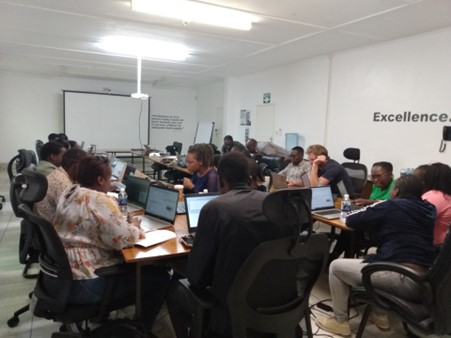
In addition to his research achievements, TAAI also highlighted Chawezi’s dedication to capacity building and mentorship. Through participatory workshops in Kenya and Zimbabwe, he has trained young agriculturalists in essential skills such as data analysis and evidence-based decision-making. His teaching experience with postgraduate students at Wageningen University further reflects his commitment to supporting and inspiring the next generation of agricultural scientists.
Chawezi’s PhD supervisor Professor Murray Lark from University of Nottingham added, “Agronomists use the yield-gap concept to address challenging problems, and Chawezi in his PhD research, developed a statistical framework in which it can be applied robustly and repeatably. He developed a software library for the R platform, which makes the methods generally available, and developed it in consultation with researchers through workshops at CGIAR centres in Africa which highlighted his skills as a teacher and communicator. It will be exciting to see what he does next!”
Reflecting on the award, Chawezi said
“I am deeply honoured by this recognition. My hope has always been to use data and research to strengthen the foundations of sustainable agriculture and ensure that farmers, especially those in resource-limited settings, benefit from insights that are both accurate and practical. This award strengthens my commitment to continue developing work that makes a real difference on the ground.I also hope this moment encourages young agricultural scientists to step forward with confidence, because your ideas matter, your leadership is needed, and your research can shape the future of farming. The world depends on bold, inquisitive thinkers, and I am confident that the next generation will lead us toward more resilient and productive agricultural systems.”
Rothamsted Research is the longest-running agricultural research institute in the world. We work from gene to field with a proud history of ground-breaking
discoveries in areas as diverse as crop management, statistical interpretation and soil health. Our founders, in 1843, were the pioneers of modern
agriculture, and we are known for our imaginative science and our collaborative approach to developing innovative farm practice.
Through independent research, we make significant contributions to improving agri-food systems in the UK and internationally, with
economic impact estimated to exceed £3 bn in annual contribution to the UK economy. Our strength lies in our systems approach, which combines strategic research,
interdisciplinary teams and multiple partnerships.
Rothamsted is home to three unique National Bioscience Research Infrastructures which are open to researchers from all over the world:
The Long-Term Experiments,
Rothamsted Insect Survey and the
North Wyke Farm Platform.
We are strategically funded by the Biotechnology and Biological Sciences Research Council (BBSRC), with additional support from other national and
international funding streams, and from industry. We are also supported by the Lawes Agricultural Trust (LAT).
The Biotechnology and Biological Sciences Research Council is part of UK Research and Innovation, a non-departmental public body funded by a grant-in-aid
from the UK government.
BBSRC invests to push back the frontiers of biology and deliver a healthy, prosperous and sustainable future. Through our investments, we build and support a vibrant,
dynamic and inclusive community which delivers ground-breaking discoveries and develops bio-based solutions that contribute to tackling global challenges,
such as sustainable food production, climate change, and healthy ageing.
As part of UK Research and Innovation (UKRI), we not only play a pivotal role in fostering connections that enable the UK’s world-class research and innovation system
to flourish – we also have a responsibility to enable the creation of a research culture that is diverse, resilient, and engaged.
BBSRC proudly forges interdisciplinary collaborations where excellent bioscience has a fundamental role. We pioneer approaches that enhance the equality, diversity,
and inclusion of talent by investing in people, infrastructure, technologies, and partnerships on a global scale.
The Lawes Agricultural Trust, established in 1889 by Sir John Bennet Lawes, supports Rothamsted Research’s national and international agricultural science through the provision of land, facilities and funding. LAT, a charitable trust, owns the estates at Harpenden and Broom's Barn, including many of the buildings used by Rothamsted Research. LAT provides an annual research grant to the Director, accommodation for nearly 200 people, and support for fellowships for young scientists from developing countries. LAT also makes capital grants to help modernise facilities at Rothamsted, or invests in new buildings.