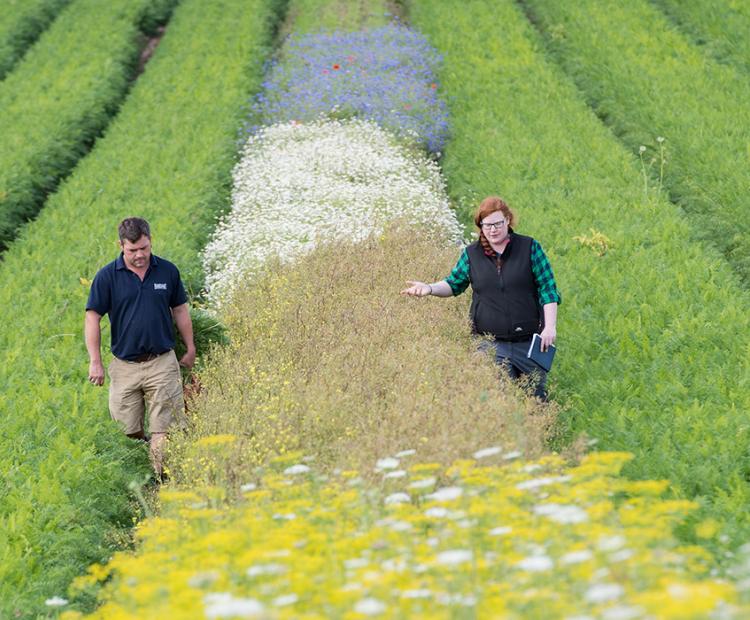
The big picture: using wildflower strips for pest control
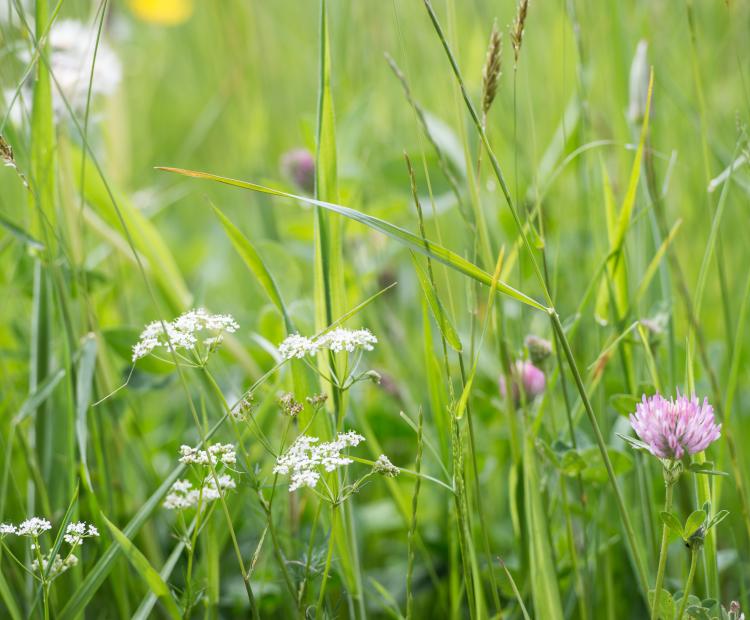
They may be beautiful, but these strips prove pretty deadly for every farmer's mortal enemy: aphids
Drought stress is one of the most significant challenges to global crop production, particularly when it occurs during the reproductive phase of crop development. Water deficit during flowering, fertilisation and early seed formation can severely disrupt pollen development, fertilisation success and grain set, resulting in substantial reductions in yield and seed quality. As climate change increases the frequency and unpredictability of drought events, there is an urgent need to develop innovative strategies that enable crops to maintain productivity under water-limited conditions.
We are seeking an enthusiastic and motivated PhD candidate to join an interdisciplinary research project focused on understanding and mitigating reproductive-stage drought damage in wheat and soybeans. The project will investigate how soil water deficit affects critical reproductive processes and evaluates novel approaches to enhance crop resilience through physiological, molecular and agronomic interventions. Using advanced phenotyping approaches, the project will assess pollen viability, stigma receptivity, fertilisation success and early grain development under varying levels of water stress and exogenous mitigation treatments. Stable isotope analysis of carbon, nitrogen and oxygen will be used to provide mechanistic insights into how various interventions influence plant physiological responses to drought. The project integrates bioimaging and physiological measurements to identify key pathways associated with reproductive resilience. These data will be incorporated into predictive modelling frameworks to identify drought-sensitive developmental windows and optimise intervention strategies.
This multidisciplinary project brings together expertise from Rothamsted Research, the University of Exeter, and Syngenta. The candidate will receive generous salary package. The student will receive training in plant physiology, stable isotope techniques, metabolomics, bioinformatics, statistical analysis and systems modelling. Through a combination of laboratory, controlled-environment and data-driven research, the project aims to generate new knowledge on reproductive drought tolerance while developing practical strategies to improve crop performance under increasingly variable climatic conditions. We are looking for candidates with an interest in plant stress biology, crop physiology, systems modelling and data analysis within a collaborative and supportive research environment. For informal queries, please contact: hari.upadhayay@rothamsted.ac.uk and/or I.Hartley@exeter.ac.uk.
To be eligible for a fully-funded studentship, you must meet the below academic and residence criteria.
Applicants for a studentship must have obtained, or be about to obtain, a First or Upper Second Class UK Honours degree, or the equivalent qualifications gained outside the UK, in an appropriate area of science or technology. Applicants with a Lower Second Class degree will be considered if they also have a Master’s degree or have significant relevant research or non-academic experience.
In addition, due to the strong quantitative component of the taught course in the first year and the quantitative emphasis in our projects, quantitative experience is needed. We recognise this can be demonstrated through a number of options, and have included some examples below (this is not an exhaustive list):
*Significant quantitative component examples include statistics, bioinformatics, maths, physics, data analysis, computation.
Of note: a limited number of our PhD projects may have a greater quantitative emphasis and require advanced quantitative experience. These expectations will be outlined by the PhD project supervisor.
Applicants must ensure they highlight their quantitative background within their application (i.e. the quantitative techniques used and how applied).
To support accessibility to PhD training opportunities, these studentships are only available to applicants that have not previously obtained or about to obtain a PhD degree (or equivalent).
If your first language is not English, you will need to meet the minimum English requirements for the programme. Further information about these English requirements >>
We ask that the language requirements are met by 1st June at the latest, to allow adequate time to obtain any necessary documentation to allow you to study in the UK. Further information about documentation required >>
IMPORTANT: Residency requirements are complex and too detailed to capture in full below. So please read alongside guidance provided on the GOV.UK website and UKCISA website to ensure you meet the criteria.
Home students
Fully-funded studentships are available for Home students. To be classed as a Home student, candidates must meet the following criteria:
International students
If you do not meet the above criteria, you will be classed as an International student.
A limited number (up to 30%) of UKRI fully-funded studentships are available through the SWBio DTP, that applicants who would be classed as an International student are eligible for. This also means that there are normally no restrictions on applying to any project that is advertised (unless otherwise indicated). Please apply through our normal application route.
Note: A UKRI fully-funded studentship will only cover what is listed under the ‘UKRI-BBSRC funded studentship‘ section. However there may be other costs that you may encounter and need to take into consideration which will not be covered by the studentship. For example, visa fees, healthcare surcharge and relocation costs .
Projects advertised during the main SWBio DTP recruitment period (this period will be indicated by an application deadline) are all 4 years fully-funded (subject to being made a studentship offer following the SWBio interview day).
A fully-funded four year SWBio DTP studentship will cover:
A limited number (up to 30%) of UKRI fully-funded studentships are available through the SWBio DTP, that applicants who would be classed as an International student are eligible for. This also means that there are normally no restrictions on applying to any project that is advertised (unless otherwise indicated). Further information about residence criteria
* An enhanced stipend is available for students with a recognised veterinary degree qualification. There may also be enhanced stipends associated with projects that have a CASE partner (CASE projects are highlighted as *CASE in the project lists).
** International students will not be required to cover the difference between home and international tuition fees.
Please visit Funding – SWBiosciences Doctoral Training Partnership for further details on stipends and further details for international students.
For further details on how to apply for this studentship project, please visit the SWBio web pages.