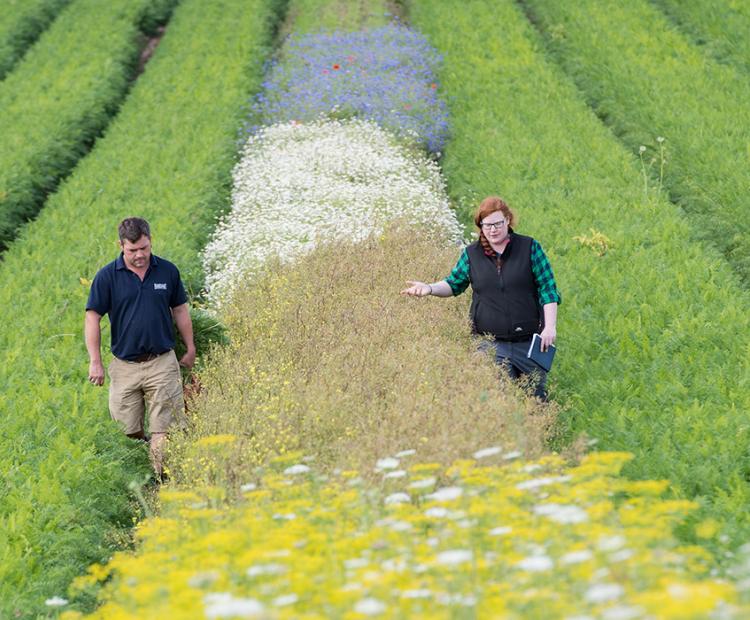
The big picture: using wildflower strips for pest control
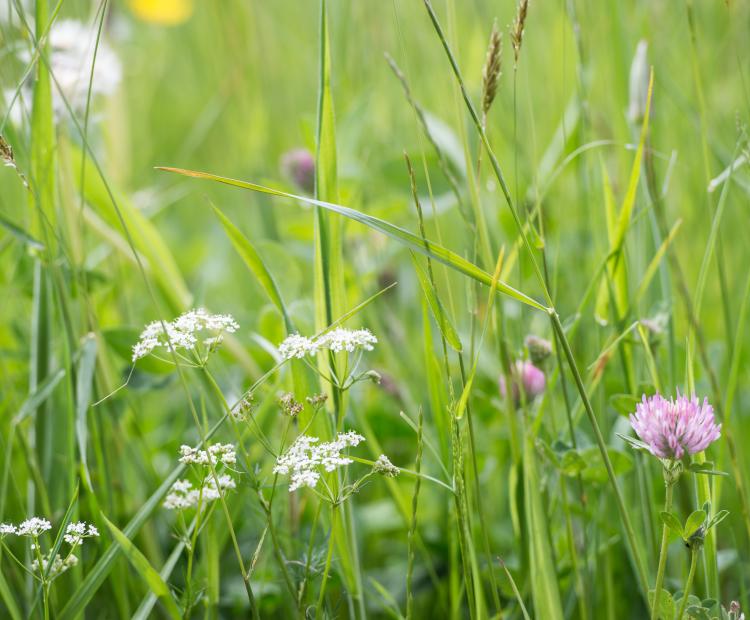
They may be beautiful, but these strips prove pretty deadly for every farmer's mortal enemy: aphids
Researchers Prof. Jonathan Storkey from Rothamsted Research and Prof. Richard Pywell from UK-CEH met with Members of Parliament and peers in Westminster on Wednesday 8th July to present their latest insights on “What should we use land for? New evidence shows where and how to deliver the land use framework”. Jonathan and Richard collaborate through the AgZero+ programme, aimed at enabling the transition to net-zero and climate-resilient food production.
.jpg)
As part of Evidence Week in Parliament, they made policy recommendations and highlighted the need to review current policies in light of the latest available evidence. Evidence Week is a unique annual meeting that brings together the public, parliamentarians and researchers from across the UK to discuss how evidence is used and reviewed in Parliament. They presented their findings to, amongst others, Caroline Nokes MP, Jayne Kirkham MP, Calum Miller MP, Adrian Ramsay MP, Graham Leadbitter MP, Alistair Carmichael MP and Ben Goldsborough MP equipping them with vital information to inform the decisions they make on future policies for making nature-friendly farming work in practice.
Researcher Jonathan Storkey said:
"Evidence Week provided a valuable opportunity to talk about the relevance of Institute strategically funded science to decision makers responsible for delivering the UK Land Use Framework. Tensions around maintaining productivity while delivering public goods and services were highlighted to peers and MPs, and potential routes to multifunctional land use at a regional level presented. As a researcher, it was valuable to ground public funded science in the immediate pressures and challenges for government and provided a useful learning experience in how to present science to deliver maximum impact."
Thanks to the involvement of research partners like Rothamsted Research, members of the public were able to put questions directly to MPs and Lords about evidence use on the issues that matter to them.
Evidence Week, now in its ninth year, is run by the campaigning charity Sense about Science, in partnership with communities and research institutions from across the UK. During the week, MPs meet with leading scientists to get the latest insights on pressing issues covering topics as varied as clean energy to AI sovereignty. It is an opportunity for the public, parliamentarians and researchers to come together to share knowledge and insights. It also empowers legislators to engage with evidence and equips them with critical tools to handle uncertainty, identify bias, and scrutinise underlying assumptions.
Tracey Brown, Chief Executive of Sense about Science, said:
"Between elections, Parliament is responsible for the checks and balances on government policy, for making sure that policy matches the real world and that it is based on sound evidence. Evidence Week offers politicians the chance to engage with leading research groups to discuss their latest findings and tools in rapid-fire briefings that fit between parliamentary business.”
Evidence Week in Parliament 2026 is organised by Sense about Science. Running from 6-10 July, Evidence Week opened with an in-person reverse select committee hearing where constituents asked MPs about the evidence behind policy issues that matter to them. This was followed by three days of rapid-fire policy briefings from world-class researchers for MPs and peers in Westminster. National experts trained parliamentary staff on how to understand data and research, and scrutinise reports and evidence presented to them. See https://senseaboutscience.org/evidence-week/ for the full programme.
Sense about Science is an independent charity that promotes the public interest in sound science and evidence. Founded in 2002, Sense about Science works with decision-makers, world-leading researchers and community groups to raise the standard of evidence in public life. It focuses on socially or scientifically difficult issues where evidence is neglected, conflicting or misunderstood. Visit https://senseaboutscience.org/ or email hello@senseaboutscience.org
A full list of partnering research organisations can be found here: https://senseaboutscience.org/evidence-week/policy-briefings/
Agrosystem Health and Pest Management Team Leader

Ecosystems Modeller
Rothamsted Research is the longest-running agricultural research institute in the world. We work from gene to field with a proud history of ground-breaking
discoveries in areas as diverse as crop management, statistical interpretation and soil health. Our founders, in 1843, were the pioneers of modern
agriculture, and we are known for our imaginative science and our collaborative approach to developing innovative farm practice.
Through independent research, we make significant contributions to improving agri-food systems in the UK and internationally, with
economic impact estimated to exceed £3 bn in annual contribution to the UK economy. Our strength lies in our systems approach, which combines strategic research,
interdisciplinary teams and multiple partnerships.
Rothamsted is home to three unique National Bioscience Research Infrastructures which are open to researchers from all over the world:
The Long-Term Experiments,
Rothamsted Insect Survey and the
North Wyke Farm Platform.
We are strategically funded by the Biotechnology and Biological Sciences Research Council (BBSRC), with additional support from other national and
international funding streams, and from industry. We are also supported by the Lawes Agricultural Trust (LAT).
The Biotechnology and Biological Sciences Research Council is part of UK Research and Innovation, a non-departmental public body funded by a grant-in-aid
from the UK government.
BBSRC invests to push back the frontiers of biology and deliver a healthy, prosperous and sustainable future. Through our investments, we build and support a vibrant,
dynamic and inclusive community which delivers ground-breaking discoveries and develops bio-based solutions that contribute to tackling global challenges,
such as sustainable food production, climate change, and healthy ageing.
As part of UK Research and Innovation (UKRI), we not only play a pivotal role in fostering connections that enable the UK’s world-class research and innovation system
to flourish – we also have a responsibility to enable the creation of a research culture that is diverse, resilient, and engaged.
BBSRC proudly forges interdisciplinary collaborations where excellent bioscience has a fundamental role. We pioneer approaches that enhance the equality, diversity,
and inclusion of talent by investing in people, infrastructure, technologies, and partnerships on a global scale.
The Lawes Agricultural Trust, established in 1889 by Sir John Bennet Lawes, supports Rothamsted Research’s national and international agricultural science through the provision of land, facilities and funding. LAT, a charitable trust, owns the estates at Harpenden and Broom's Barn, including many of the buildings used by Rothamsted Research. LAT provides an annual research grant to the Director, accommodation for nearly 200 people, and support for fellowships for young scientists from developing countries. LAT also makes capital grants to help modernise facilities at Rothamsted, or invests in new buildings.