The big picture: using wildflower strips for pest control
They may be beautiful, but these strips prove pretty deadly for every farmer's mortal enemy: aphids
In the late-2017 and late-2018 harvest seasons, teams working for the GeoNutrition project walked out into farmers’ fields and grain stores across Amhara, Oromia and Tigray regions of Ethiopia, and collected 1,352 soil and grain samples from 385 districts. The goal at the time was to map how micronutrient levels in Ethiopian food systems vary from place to place. Nobody involved could have known that, several years later, that same soil data would become the key piece of evidence in a very different story: explaining why an entire generation of Ethiopian children grew up to score lower on their school-leaving exams, and why some of them didn’t survive early childhood at all.
That story is told in a new study involving Rothamsted scientists, which is a striking demonstration that soil data, once collected and shared, can go on answering questions its collectors never anticipated.
A fortification programme, cut off overnight
In May 1998, war closed the border between Ethiopia and Eritrea. At the time, Ethiopia’s entire supply of iodized salt came from a single industrial facility across that border, and the closure cut it off completely. Household use of iodized salt collapsed from 80% of households in 1995 to just 4% by 2005. It took until 2012 for the government to reinstate mandatory iodization, and until 2015 for coverage to climb back above 90%.
It was a public health emergency at the time - but for researchers looking back at it now, it also provided a natural experiment at national scale, showing the impacts on human health and development when a salt iodine fortification programme fails.
Where the GeoNutrition data came in
After the onset of the war, the coverage of iodized salt fell rapidly across the whole country. To understand the impact of losing iodized salt – and to separate this from everything else going on, war included – requires some sort of variation in population iodine status.
That’s where the GeoNutrition soil and crop survey came in. Soil iodine occurs naturally at very different concentrations across Ethiopia’s farmland - organically bound iodine averaged 10.18 mg/kg across sample sites but ranged from 1.19 to 23.05 mg/kg. Mapped across all 385 districts, the resulting picture (below) shows iodine-rich pockets concentrated in western and eastern Oromia, against persistently low levels across much of Tigray and eastern Amhara - a pattern shaped by underlying geology and geochemistry. Soil selenium, sampled and measured alongside iodine, showed a quite distinct spatial pattern.
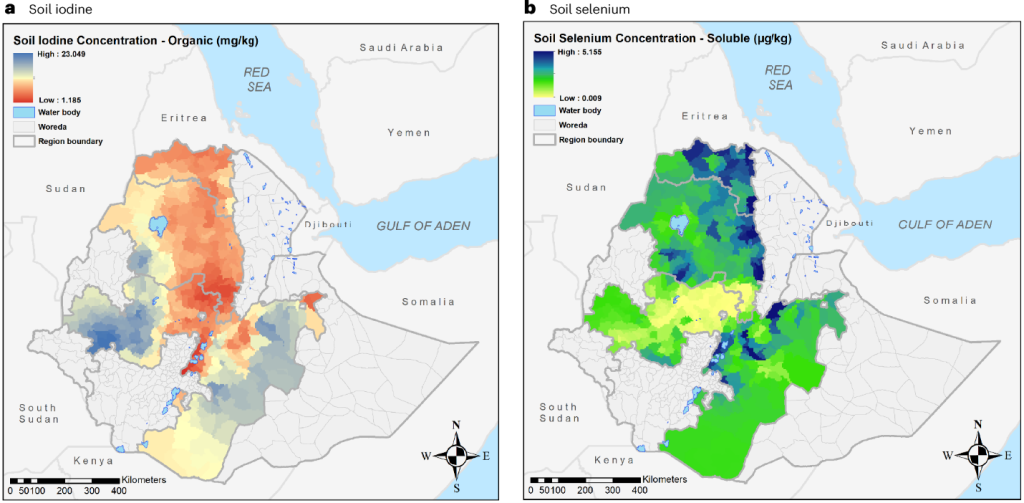
Where iodized salt disappeared, households in naturally low-iodine districts lost their only meaningful iodine source; households in naturally higher-iodine districts still had some backup from local water, pasture and food. Because cereal grains take up very little iodine from soil, the team didn’t use grain iodine concentration directly as their exposure measure. Instead, soil iodine served as a proxy for the broader environmental iodine reaching a household through diets. The researchers found that children living in districts with higher soil iodine had measurably higher urinary iodine concentrations during the period of low iodized salt coverage.
What the combined data revealed
The researchers then compared exam and survival outcomes for children born around the onset of the 1998 disruption. Drawing on exam records for over one million young Ethiopians who sat the national university entrance exam between 2003 and 2019, they found children born after the disruption scored 0.02–0.04 standard deviations lower than those born just before, with the deficit rising by a further 0.03–0.09 standard deviations for every 1 standard deviation reduction in local soil iodine. Using Demographic and Health Survey data for 8,185 rural children, they found cumulative under-five mortality reached 25–30% in the lowest-soil-iodine districts born after the disruption, against under 10% elsewhere.
To rule out other explanations, the team reran the whole analysis with soil selenium in place of soil iodine (a nutrient unaffected by the 1998 disruption) and found no significant link. They also restricted the analysis to districts around Addis Ababa where food is not necessarily grown locally, and found the effect of local soil iodine was diminished, which strengthens confidence that the findings were not an artefact of the data or the method.
Edward Joy from Rothamsted Research commented, "Soil maps aren't something you'd normally think to combine with school exam records or child mortality data — but that combination is exactly what let us isolate iodine's effect from everything else going on in Ethiopia at the time."
Why this matters for how we think about environmental data
Nature Food’s associate editor, Fiona Coleman, commented “The benefits of salt iodization cannot be taken for granted… These findings underscore the importance of resilient food systems and sustained public health interventions in safeguarding nutrition, health and human potential.”
The GeoNutrition soil and grain data used in this study was never collected with iodine fortification policy in mind. It was an effort to understand baseline dynamics of micronutrients in soils and crops. Martin Broadley from Rothamsted Research commented, "This study is a good example of what's possible when soil science and public health research are brought together. Naturally occurring soil iodine turns out to be a powerful lens for understanding population-level nutrition risk, well beyond what we originally used it for."
“Loss of salt iodization harmed child survival and academic achievement in Ethiopia,” by Robel Alemu, Kibrom Tafere, Dawd Gashu, Edward J. M. Joy, Elizabeth H. Bailey, R. Murray Lark, Martin R. Broadley and William A. Masters, is published in Nature Food, 7, 889–901 (2026) (https://doi.org/10.1038/s43016-026-01408-y).
GeoNutrition soil and grain data used in this study are reported here [Kumssa et al., 2022, Scientific Data - [https://doi.org/10.1038/s41597-022-01500-5] and available via a FigShare data repository [https://figshare.com/articles/dataset/Cereal_grain_mineral_micronutrient_and_soil_chemistry_data_from_GeoNutrition_surveys_in_Ethiopia_and_Malawi/15911973]

SENIOR RESEARCH FELLOW - FOOD SYSTEMS & NUTRITION
Rothamsted Research is the longest-running agricultural research institute in the world. We work from gene to field with a proud history of ground-breaking
discoveries in areas as diverse as crop management, statistical interpretation and soil health. Our founders, in 1843, were the pioneers of modern
agriculture, and we are known for our imaginative science and our collaborative approach to developing innovative farm practice.
Through independent research, we make significant contributions to improving agri-food systems in the UK and internationally, with
economic impact estimated to exceed £3 bn in annual contribution to the UK economy. Our strength lies in our systems approach, which combines strategic research,
interdisciplinary teams and multiple partnerships.
Rothamsted is home to three unique National Bioscience Research Infrastructures which are open to researchers from all over the world:
The Long-Term Experiments,
Rothamsted Insect Survey and the
North Wyke Farm Platform.
We are strategically funded by the Biotechnology and Biological Sciences Research Council (BBSRC), with additional support from other national and
international funding streams, and from industry. We are also supported by the Lawes Agricultural Trust (LAT).
The Biotechnology and Biological Sciences Research Council is part of UK Research and Innovation, a non-departmental public body funded by a grant-in-aid
from the UK government.
BBSRC invests to push back the frontiers of biology and deliver a healthy, prosperous and sustainable future. Through our investments, we build and support a vibrant,
dynamic and inclusive community which delivers ground-breaking discoveries and develops bio-based solutions that contribute to tackling global challenges,
such as sustainable food production, climate change, and healthy ageing.
As part of UK Research and Innovation (UKRI), we not only play a pivotal role in fostering connections that enable the UK’s world-class research and innovation system
to flourish – we also have a responsibility to enable the creation of a research culture that is diverse, resilient, and engaged.
BBSRC proudly forges interdisciplinary collaborations where excellent bioscience has a fundamental role. We pioneer approaches that enhance the equality, diversity,
and inclusion of talent by investing in people, infrastructure, technologies, and partnerships on a global scale.
The Lawes Agricultural Trust, established in 1889 by Sir John Bennet Lawes, supports Rothamsted Research’s national and international agricultural science through the provision of land, facilities and funding. LAT, a charitable trust, owns the estates at Harpenden and Broom's Barn, including many of the buildings used by Rothamsted Research. LAT provides an annual research grant to the Director, accommodation for nearly 200 people, and support for fellowships for young scientists from developing countries. LAT also makes capital grants to help modernise facilities at Rothamsted, or invests in new buildings.