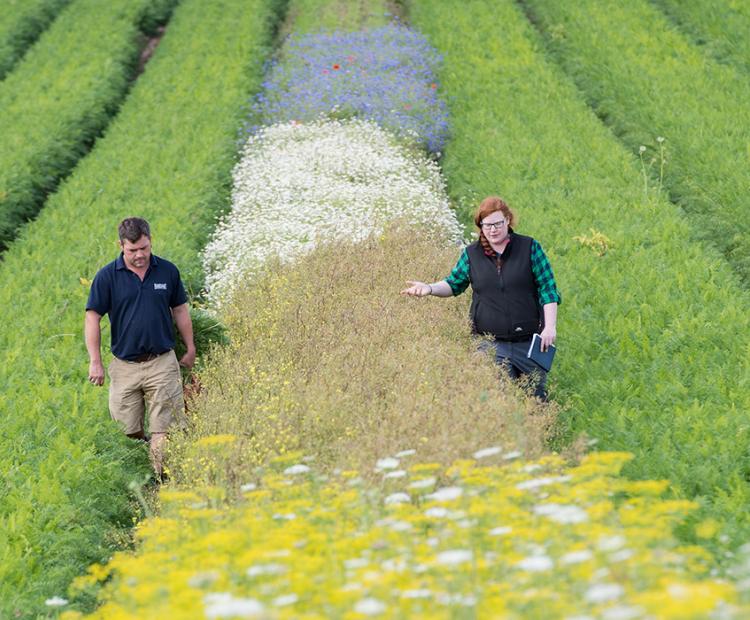
The big picture: using wildflower strips for pest control
They may be beautiful, but these strips prove pretty deadly for every farmer's mortal enemy: aphids
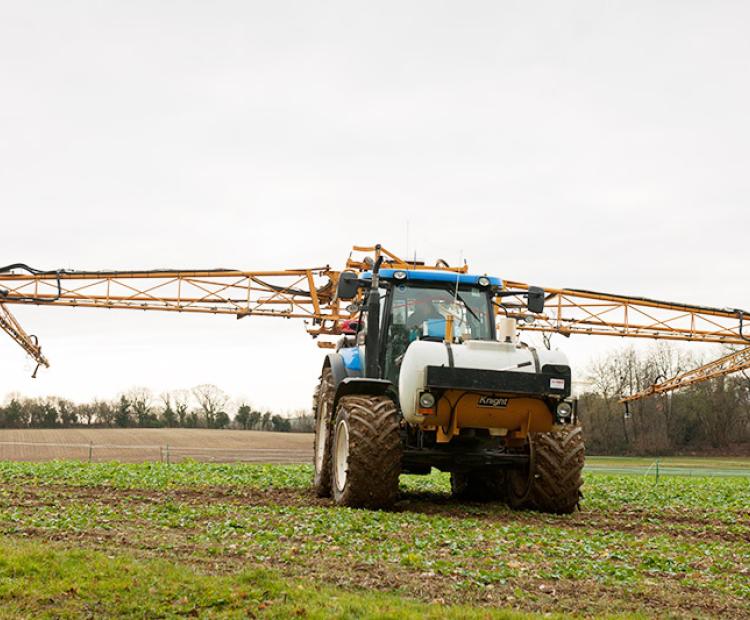
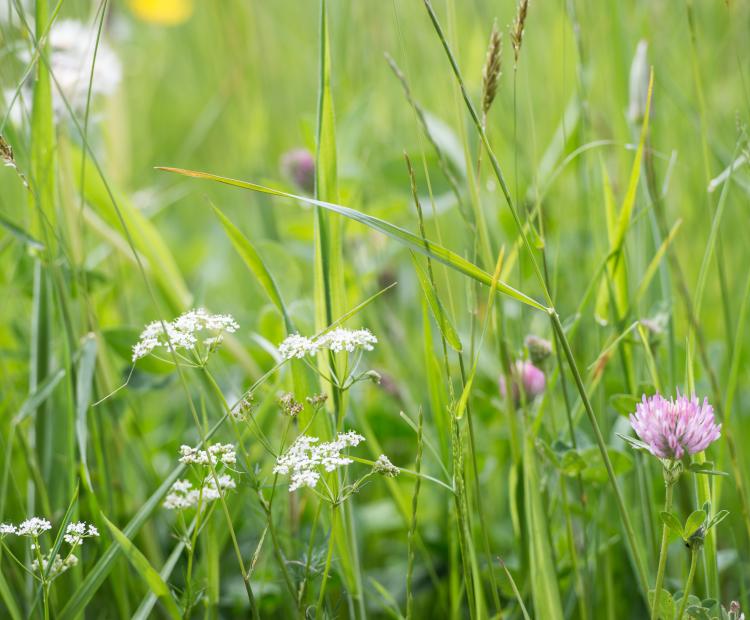
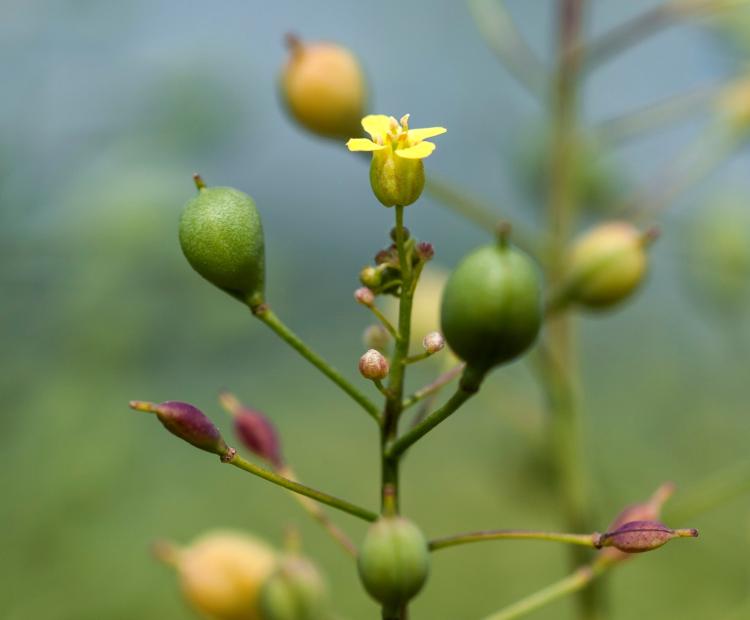
Arable plants sit at the base of the farmland food web; supporting the invertebrates and birds that depend on cropped land. As weeds, they are also a big problem for farmers and threaten our food security. Intensive agriculture aims to limit weed population size, but in doing so diversity has also been lost. Farmers are now paid to reverse biodiversity declines, while climate change, narrow profit margins, and evolving resistance to herbicides keep changing which species can persist. Whether recovery retraces the path of decline remains unknown.
Taking the pressure off after years of intensive farming may not bring the communities back. Seedbanks have been depleted and fragmented landscapes mean the nearest source populations could sit kilometres away. Agricultural systems may have crossed a tipping point beyond which recovery is slow or may need to take a different direction entirely. You will test whether arable plant communities behave this way and explore what it could take to pull them back.
This project combines fieldwork, long-term experimental data, and simulation modelling. You will quantify what survives in the soil seedbank under different types of management using a decade of data from Rothamsted’s Large Scale Rotation Experiment. You will also measure the amount and types of seed arriving into fields from field margins and semi-natural habitats. These data will feed into a plant community dynamics model, which you will extend to simulate dispersal. With it you will search for signs of tipping points, resilience, and restoration pathways for farmland biodiversity that limit costs to crop production.
You will join a team spanning ecology, herbicide resistance, agricultural modelling, and resilience theory at Rothamsted Research and the University of Bristol, with additional input from industry professionals at Syngenta. Training will cover plant identification, field techniques, analysis of long term data, and process-based modelling.
To be eligible for a fully-funded studentship, you must meet the below academic and residence criteria.
Applicants for a studentship must have obtained, or be about to obtain, a First or Upper Second Class UK Honours degree, or the equivalent qualifications gained outside the UK, in an appropriate area of science or technology. Applicants with a Lower Second Class degree will be considered if they also have a Master’s degree or have significant relevant research or non-academic experience.
In addition, due to the strong quantitative component of the taught course in the first year and the quantitative emphasis in our projects, quantitative experience is needed. We recognise this can be demonstrated through a number of options, and have included some examples below (this is not an exhaustive list):
*Significant quantitative component examples include statistics, bioinformatics, maths, physics, data analysis, computation.
Of note: a limited number of our PhD projects may have a greater quantitative emphasis and require advanced quantitative experience. These expectations will be outlined by the PhD project supervisor.
Applicants must ensure they highlight their quantitative background within their application (i.e. the quantitative techniques used and how applied).
To support accessibility to PhD training opportunities, these studentships are only available to applicants that have not previously obtained or about to obtain a PhD degree (or equivalent).
If your first language is not English, you will need to meet the minimum English requirements for the programme. Further information about these English requirements >>
We ask that the language requirements are met by 1st June at the latest, to allow adequate time to obtain any necessary documentation to allow you to study in the UK. Further information about documentation required >>
IMPORTANT: Residency requirements are complex and too detailed to capture in full below. So please read alongside guidance provided on the GOV.UK website and UKCISA website to ensure you meet the criteria.
Home students
Fully-funded studentships are available for Home students. To be classed as a Home student, candidates must meet the following criteria:
International students
If you do not meet the above criteria, you will be classed as an International student.
A limited number (up to 30%) of UKRI fully-funded studentships are available through the SWBio DTP, that applicants who would be classed as an International student are eligible for. This also means that there are normally no restrictions on applying to any project that is advertised (unless otherwise indicated). Please apply through our normal application route.
Note: A UKRI fully-funded studentship will only cover what is listed under the ‘UKRI-BBSRC funded studentship‘ section. However there may be other costs that you may encounter and need to take into consideration which will not be covered by the studentship. For example, visa fees, healthcare surcharge and relocation costs .
Projects advertised during the main SWBio DTP recruitment period (this period will be indicated by an application deadline) are all 4 years fully-funded (subject to being made a studentship offer following the SWBio interview day).
A fully-funded four year SWBio DTP studentship will cover:
A limited number (up to 30%) of UKRI fully-funded studentships are available through the SWBio DTP, that applicants who would be classed as an International student are eligible for. This also means that there are normally no restrictions on applying to any project that is advertised (unless otherwise indicated). Further information about residence criteria
* An enhanced stipend is available for students with a recognised veterinary degree qualification. There may also be enhanced stipends associated with projects that have a CASE partner (CASE projects are highlighted as *CASE in the project lists).
** International students will not be required to cover the difference between home and international tuition fees.
Please visit Funding – SWBiosciences Doctoral Training Partnership for further details on stipends and further details for international students.
For further details on how to apply for this studentship project, please visit the SWBio web pages.