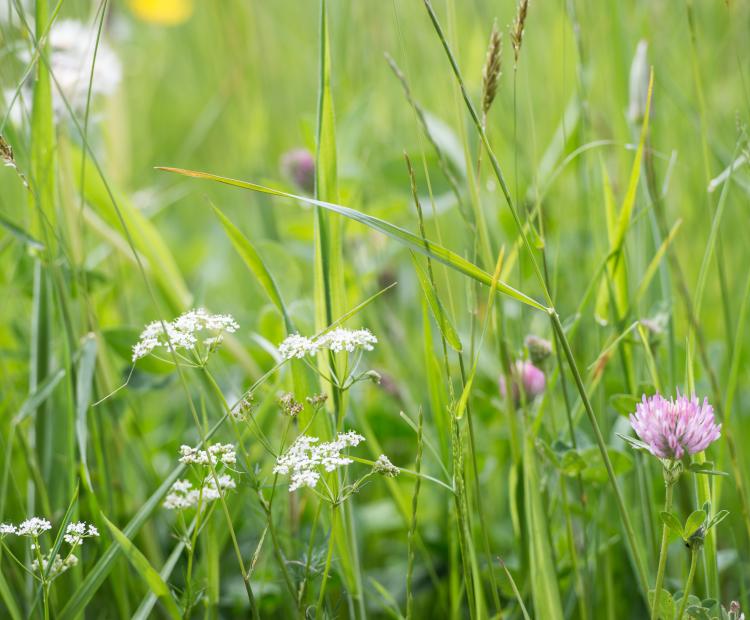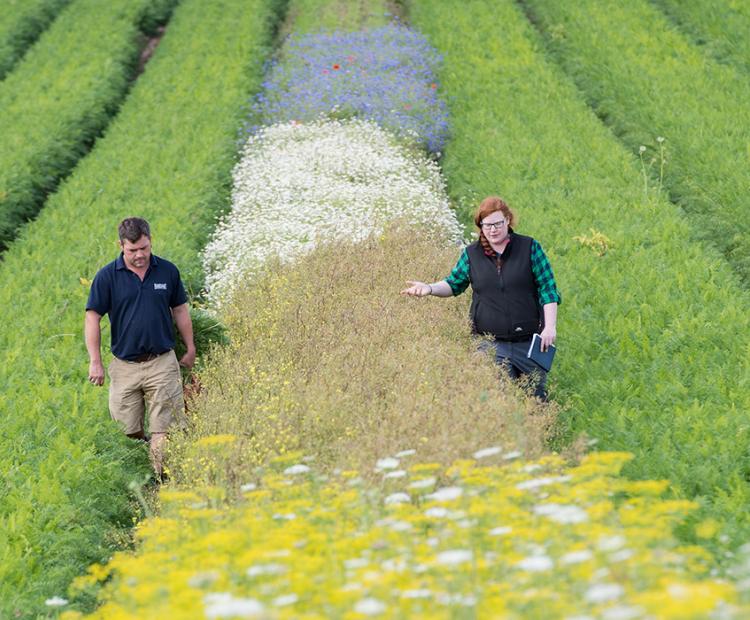
The big picture: using wildflower strips for pest control
They may be beautiful, but these strips prove pretty deadly for every farmer's mortal enemy: aphids
Can microbes help solve one of agriculture's biggest challenges: weed control?
This PhD will investigate whether naturally occurring soil microbes and the bioactive compounds they produce can be developed into sustainable alternatives to conventional weed management. Using unique microbial resources from the UK Crop Microbiome Cryobank, the student will identify microbial strains capable of suppressing blackgrass, the UK's most problematic and economically important weed. To be effective in agricultural systems, candidate microbes must suppress weeds while remaining compatible with the crop. The student will therefore evaluate the effects of microbial strains and their bioactive compounds on oat performance, reflecting the crop's increasing importance within resilient cereal production systems and its central role within the Jordans Cereals supply chain.
Working across microbiology, plant science, metabolomics and data science, the student will isolate and characterise promising microbial candidates, investigate the mechanisms through which they suppress blackgrass and evaluate their compatibility for use by oat growers. The project is an exciting opportunity to combine fundamental biological discovery with real-world application and will be undertaken in collaboration with Rothamsted Research, Jordans Cereals and the University of Bath.
This fully-funded four-year PhD operates within the SWBio DTP and includes an enhanced stipend and additional research funding from Jordans Cereals. The student will join a collaborative research environment and contribute to the development of sustainable biological solutions and leave prepared for careers across academia and industry. They will receive training in microbial culturing, molecular biology, plant phenotyping, controlled-environment experimentation, 'omics technologies, bioinformatics, and quantitative data analysis. Through involvement with Jordans Cereals, they will have the opportunity to interact with members of the wider agri-food supply chain and gain an understanding of the challenges that transitioning to a sustainable farming system pose.
The project leverages the team’s extensive research infrastructure, specialist facilities and interdisciplinary expertise, contributing to sustainable weed management strategies and UK farming resilience. It aligns with the growing demand for sustainable farming practices and offers the potential to develop microbial biocontrol products that reduce chemical inputs and safeguard productivity in oat fields, even against herbicide-resistant weeds.
We are committed to providing a supportive and inclusive research environment. You will be part of a collaborative team and benefit from tailored mentorship, professional development opportunities, and engagement with both academic and industry partners. Whether your interests lie in plant science, microbiology, or sustainable agriculture, this project provides a strong foundation for a career in research and innovation
Eligibility
To be eligible for a fully-funded studentship, you must meet the below academic and residence criteria.
Applicants for a studentship must have obtained, or be about to obtain, a First or Upper Second Class UK Honours degree, or the equivalent qualifications gained outside the UK, in an appropriate area of science or technology. Applicants with a Lower Second Class degree will be considered if they also have a Master’s degree or have significant relevant research or non-academic experience.
In addition, due to the strong quantitative component of the taught course in the first year and the quantitative emphasis in our projects, quantitative experience is needed. We recognise this can be demonstrated through a number of options, and have included some examples below (this is not an exhaustive list):
*Significant quantitative component examples include statistics, bioinformatics, maths, physics, data analysis, computation.
Of note: a limited number of our PhD projects may have a greater quantitative emphasis and require advanced quantitative experience. These expectations will be outlined by the PhD project supervisor.
Applicants must ensure they highlight their quantitative background within their application (i.e. the quantitative techniques used and how applied).
To support accessibility to PhD training opportunities, these studentships are only available to applicants that have not previously obtained or about to obtain a PhD degree (or equivalent).
If your first language is not English, you will need to meet the minimum English requirements for the programme. Further information about these English requirements >>
We ask that the language requirements are met by 1st June at the latest, to allow adequate time to obtain any necessary documentation to allow you to study in the UK. Further information about documentation required >>
IMPORTANT: Residency requirements are complex and too detailed to capture in full below. So please read alongside guidance provided on the GOV.UK website and UKCISA website to ensure you meet the criteria.
Home students
Fully-funded studentships are available for Home students. To be classed as a Home student, candidates must meet the following criteria:
International students
If you do not meet the above criteria, you will be classed as an International student.
A limited number (up to 30%) of UKRI fully-funded studentships are available through the SWBio DTP, that applicants who would be classed as an International student are eligible for. This also means that there are normally no restrictions on applying to any project that is advertised (unless otherwise indicated). Please apply through our normal application route.
Note: A UKRI fully-funded studentship will only cover what is listed under the ‘UKRI-BBSRC funded studentship‘ section. However there may be other costs that you may encounter and need to take into consideration which will not be covered by the studentship. For example, visa fees, healthcare surcharge and relocation costs .
Projects advertised during the main SWBio DTP recruitment period (this period will be indicated by an application deadline) are all 4 years fully-funded (subject to being made a studentship offer following the SWBio interview day).
A fully-funded four year SWBio DTP studentship will cover:
A limited number (up to 30%) of UKRI fully-funded studentships are available through the SWBio DTP, that applicants who would be classed as an International student are eligible for. This also means that there are normally no restrictions on applying to any project that is advertised (unless otherwise indicated). Further information about residence criteria
* An enhanced stipend is available for students with a recognised veterinary degree qualification. There may also be enhanced stipends associated with projects that have a CASE partner (CASE projects are highlighted as *CASE in the project lists).
** International students will not be required to cover the difference between home and international tuition fees.
Please visit Funding – SWBiosciences Doctoral Training Partnership for further details on stipends and further details for international students.
For further details on how to apply for this studentship project, please visit the SWBio web pages.