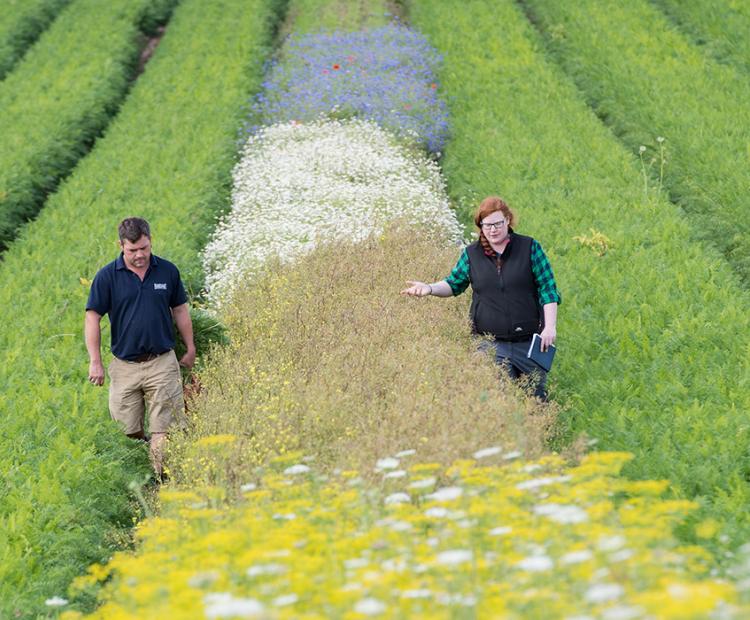
The big picture: using wildflower strips for pest control
They may be beautiful, but these strips prove pretty deadly for every farmer's mortal enemy: aphids
Launching today, the project titled “Epidemic Preparedness phase II (E-Prep II)” is led by Keele University and brings together researchers from eight organisations across the UK. At Rothamsted Research, the project involves Dr Alice Milne and Dr Helen Metcalfe, both Agricultural Systems Modellers, and Dr Lawrence Bramham, a Molecular Plant Virologist/Entomologist and Head of the Rothamsted Insect Survey.
Although the bacterial diseases being studied are not currently believed to be established in the UK, the sap-feeding insects that can spread them, known as planthoppers, are already present. Across parts of continental Europe, these diseases are affecting crops including potatoes, sugar beet, carrots and grapevines, reducing yields and crop quality. Researchers believe this creates an important opportunity to improve understanding of the risks and strengthen preparedness before significant outbreaks occur in the UK.
The four-year E-Prep II project will investigate a complex disease system involving two species of planthopper capable of transmitting five bacterial diseases between crops and wild plant hosts. The consortium will explore the biological, ecological, economic and social dimensions of these emerging threats, developing new tools to improve understanding, monitoring and risk assessment.
Dr Lawrence Bramham commented, “By bringing together expansive expertise spanning scientific disciplines, whilst also ensuring engagement with policymakers and industry stakeholders, I have no doubt the outputs from this project will ensure research findings inform future plant health policy, on-farm decision-making, and prove impactful for related science beyond the specific remits we are to explore. This is an excellent opportunity to a tackle what can be viewed in every sense to be a “complex threat” by efficiently bringing together what is a highly synergistic expert team.”
Collaboration to protect crop resilience and food security
The E-Prep II consortium includes researchers from Keele University, Rothamsted Research, the Animal and Plant Health Agency (APHA), Fera Science, and the Universities of Exeter, Gloucestershire, Warwick and York.
E-Prep II is one of 18 new research and innovation projects receiving a share of more than £54 million in public investment coordinated through UK Research and Innovation (UKRI), with co-funding from partners including the Department for Environment, Food and Rural Affairs (Defra), the Foreign, Commonwealth and Development Office (FCDO), and the Department of Health and Social Care (DHSC).

Head of the Rothamsted Insect Survey
Rothamsted Research is the longest-running agricultural research institute in the world. We work from gene to field with a proud history of ground-breaking
discoveries in areas as diverse as crop management, statistical interpretation and soil health. Our founders, in 1843, were the pioneers of modern
agriculture, and we are known for our imaginative science and our collaborative approach to developing innovative farm practice.
Through independent research, we make significant contributions to improving agri-food systems in the UK and internationally, with
economic impact estimated to exceed £3 bn in annual contribution to the UK economy. Our strength lies in our systems approach, which combines strategic research,
interdisciplinary teams and multiple partnerships.
Rothamsted is home to three unique National Bioscience Research Infrastructures which are open to researchers from all over the world:
The Long-Term Experiments,
Rothamsted Insect Survey and the
North Wyke Farm Platform.
We are strategically funded by the Biotechnology and Biological Sciences Research Council (BBSRC), with additional support from other national and
international funding streams, and from industry. We are also supported by the Lawes Agricultural Trust (LAT).
The Biotechnology and Biological Sciences Research Council is part of UK Research and Innovation, a non-departmental public body funded by a grant-in-aid
from the UK government.
BBSRC invests to push back the frontiers of biology and deliver a healthy, prosperous and sustainable future. Through our investments, we build and support a vibrant,
dynamic and inclusive community which delivers ground-breaking discoveries and develops bio-based solutions that contribute to tackling global challenges,
such as sustainable food production, climate change, and healthy ageing.
As part of UK Research and Innovation (UKRI), we not only play a pivotal role in fostering connections that enable the UK’s world-class research and innovation system
to flourish – we also have a responsibility to enable the creation of a research culture that is diverse, resilient, and engaged.
BBSRC proudly forges interdisciplinary collaborations where excellent bioscience has a fundamental role. We pioneer approaches that enhance the equality, diversity,
and inclusion of talent by investing in people, infrastructure, technologies, and partnerships on a global scale.
The Lawes Agricultural Trust, established in 1889 by Sir John Bennet Lawes, supports Rothamsted Research’s national and international agricultural science through the provision of land, facilities and funding. LAT, a charitable trust, owns the estates at Harpenden and Broom's Barn, including many of the buildings used by Rothamsted Research. LAT provides an annual research grant to the Director, accommodation for nearly 200 people, and support for fellowships for young scientists from developing countries. LAT also makes capital grants to help modernise facilities at Rothamsted, or invests in new buildings.